“It’s free money” is the single most common piece of advice about a 401(k) employer match, and it’s true as far as it goes. What that phrase leaves out is that the money isn’t handed to you automatically. You have to contribute enough of your own paycheck to unlock all of it, and in a lot of plans, you have to stay employed long enough to actually own it. Skip either step and “free money” quietly becomes money that was offered and never collected.
What an employer match actually is
A 401(k) match is money your employer adds to your retirement account on top of your salary, tied directly to how much you personally contribute. It is not a flat bonus — if you contribute nothing, most plans match nothing. The two most common structures are a dollar-for-dollar match up to some percentage of pay (“we match 100% of the first 3% you contribute”) and a partial match over a wider band (“we match 50% of the first 6% you contribute”). Both formulas can produce the identical maximum dollar amount; they differ in how much you have to contribute to reach it, so the percentage alone doesn’t tell you what to do — the full formula does.
According to Vanguard’s How America Saves 2026 report, the average employer matching contribution reached a record 4.7% of pay in 2025, while the average employee savings rate hit 12.1%, also an all-time high. Those are averages across Vanguard’s recordkeeping client base, not a promise about any specific employer’s plan — the only formula that matters is the one printed in your own plan’s summary plan description.
The first hurdle: contributing enough to get all of it
Employer contributions only match what you put in, so under-contributing doesn’t just mean you save less of your own money — it means you forfeit part of the match too, and that part isn’t something you can go back and claim later.
Here’s a worked example (the salary and formula are invented for illustration — the arithmetic is real). Say you earn $60,000 a year and your plan matches 50% of the first 6% of pay you contribute:
- Contribute 6% of pay ($3,600/year): the employer adds 50% of that, or $1,800/year — the maximum this plan will match.
- Contribute 3% of pay ($1,800/year): the employer adds 50% of that, or $900/year.
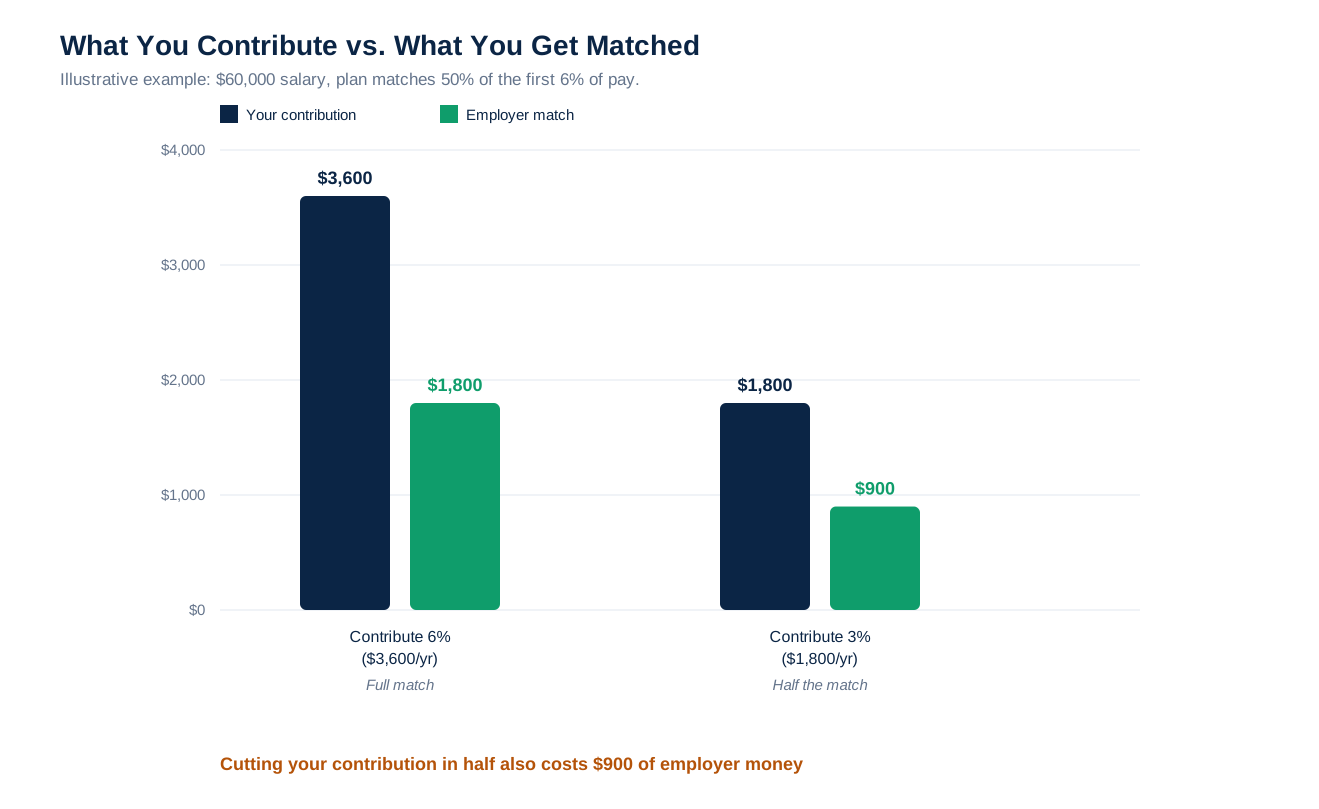
Cutting your own contribution in half didn’t just cost you $1,800 of your own savings — it cost you $900 of employer money you were otherwise entitled to, money that would have kept compounding for however many years remain until retirement. That gap only shows up if you compare your contribution rate against the plan’s specific match formula, which is why checking the exact percentage in your plan document (not a rule of thumb from a coworker) is the first thing worth doing.
The second hurdle: staying long enough to keep it
This is the part “free money” leaves out entirely. Your own contributions are always 100% yours the moment they’re deducted from your paycheck. Employer matching contributions can be subject to a vesting schedule — a waiting period tied to years of service before that money is legally yours to keep if you leave the job.
Federal law caps how long a plan can make you wait. Under the Employee Retirement Income Security Act (ERISA), codified at 26 U.S.C. § 411(a)(2)(B), a plan’s vesting schedule for matching contributions can be no slower than one of two options:
- 3-year cliff vesting: 0% vested until you complete 3 years of service, then 100% vested all at once.
- 6-year graded vesting: 20% vested at 2 years of service, 40% at 3 years, 60% at 4 years, 80% at 5 years, and 100% at 6 years.
Those are the slowest schedules the law allows — plans are free to vest faster, and many do. There’s an important carve-out: safe harbor 401(k) plans and SIMPLE 401(k) plans generally must vest matching contributions immediately, precisely because those plan designs trade faster vesting for other tax advantages. Whether your plan uses a vesting schedule at all, and which one, is stated in your plan’s summary plan description — never assume based on a schedule you had at a previous job.
Leave before you’re vested, and the unvested portion of the employer match is forfeited back to the plan — not paid out to you, not rolled over. Your own contributions and any investment growth on them go with you regardless; it’s specifically the employer’s matching dollars that can be at risk on a specific timeline.
How the match interacts with 2026 contribution limits
The match doesn’t count against the limit on what you personally can defer from your paycheck, but it does count against a separate, higher ceiling on total contributions to the account. For 2026, per IRS Notice 2025-67:
- Employee elective deferral limit: $24,500 (up from $23,500 in 2025) — this is the cap on your own paycheck contributions, traditional plus Roth combined.
- Catch-up contribution, age 50 and older: an additional $8,000 (up from $7,500), for a combined $32,500 in employee deferrals.
- Catch-up contribution, ages 60–63 specifically (the SECURE 2.0 “super catch-up”): $11,250, unchanged from 2025, replacing the standard catch-up for that age band only.
- Overall annual additions limit (employee + employer combined): $72,000 for 2026 (up from $70,000), or higher for workers eligible for a catch-up contribution.
In practice, the employer match rarely pushes a typical saver anywhere near that combined $72,000 ceiling — it mostly matters for higher earners at generous-match employers, or anyone also making after-tax contributions inside the plan. For nearly everyone else, the number that actually determines whether you get the full match is the contribution percentage in your plan’s formula, not either federal limit.
Common ways people leave match money unclaimed
A few patterns show up repeatedly, none of which require anything unusual to happen:
- Contributing a flat dollar amount instead of a percentage. A fixed $200/paycheck can quietly fall under the match threshold after a raise, since the match formula is based on a percentage of current pay, not a dollar figure that was right last year.
- Starting mid-year without checking a “true-up.” Some plans calculate the match per pay period; if you front-load contributions early in the year and hit your personal deferral limit before December, you can miss employer match on paychecks after that unless your specific plan has a true-up provision that corrects it at year-end. Not all plans do — this is a question worth asking HR or the plan administrator directly, not assuming either way.
- Leaving a job right before a vesting date. Checking your vesting schedule before a resignation date, when the choice of timing is yours, is a five-minute check that can be worth thousands of employer dollars.
None of this is a case for or against any specific employer, fund, or investment choice inside the plan — it’s simply about collecting the match your plan already offers, in full, before deciding anything else.
Questions about the arithmetic above, or think we got a number wrong? Write to us at Info@smartfinclub.com.