Disclosure first. SmartFinClub's founder is a registered real estate agent, which means we earn a living from the very service this article says you can sometimes do without. We are telling you that before anything else so you can weigh what follows accordingly. Where the numbers favor going it alone, we say so.
Every few months someone asks the same question: do I actually need a realtor to buy a house? The legal answer is generally no. The practical answer depends on what you would be taking on yourself, and on whether the fee you think you are saving is real. Here is what the national data says, what you gain and risk, and how to decide.
What the national numbers say
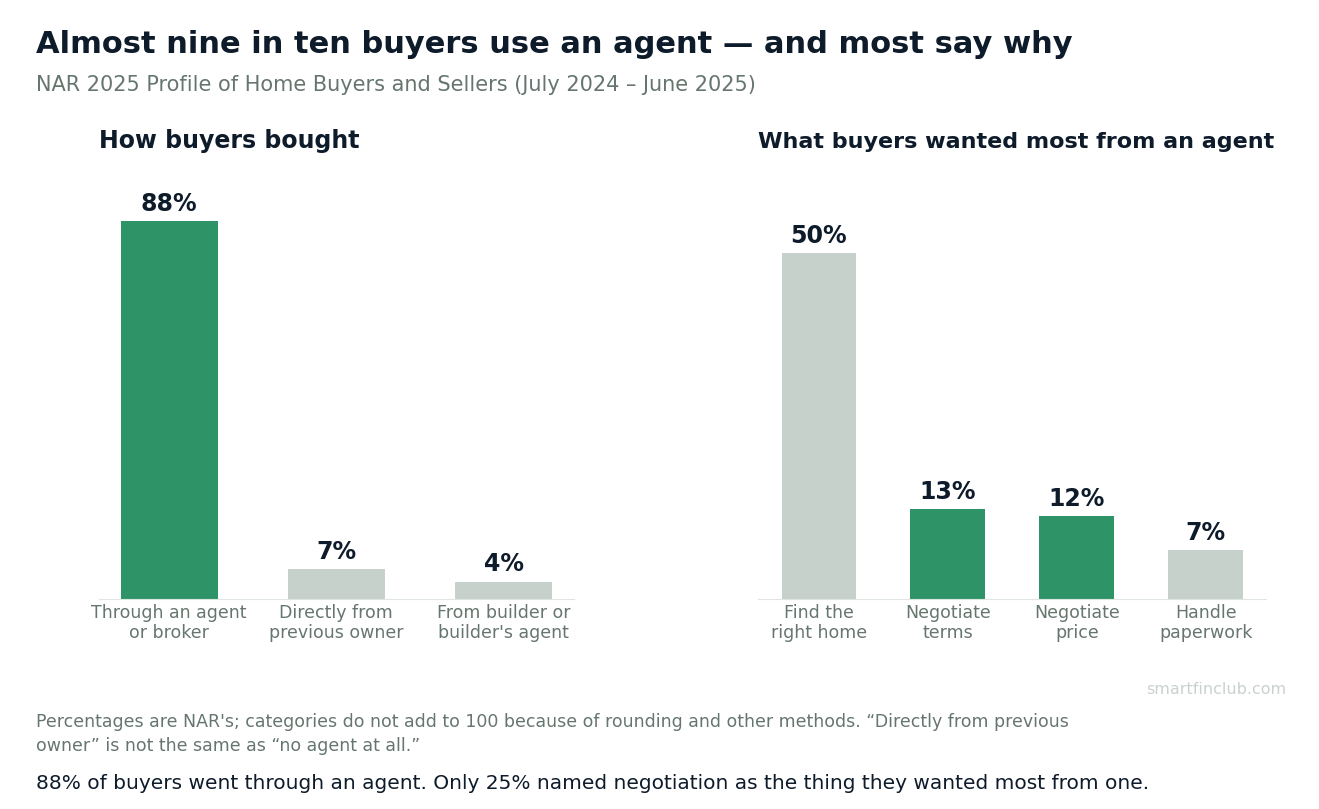
The National Association of Realtors surveys recent buyers every year. In its 2025 profile, covering purchases from July 2024 through June 2025, 88% of buyers bought through an agent or broker. 7% bought directly from the previous owner, and 4% bought from a builder or the builder's agent. On the sell side, 91% of sellers used an agent and 5% sold on their own, an all-time low.
Two cautions before you read too much into those figures. First, NAR does not publish a clean “no agent at all” number for buyers. Someone who buys directly from a previous owner may still have hired an agent, and someone who buys from a builder is often dealing with the builder's sales agent. Second, NAR's own data show why the sellers who skip an agent are unusual: 60% of for-sale-by-owner sellers already knew the buyer. Those are family sales, friend sales and neighbor sales, which are a different animal from a stranger buying at market.
The same survey asked buyers what they most wanted from their agent. 50% said help finding the right home. 13% said help negotiating the terms of sale, and 12% said help with price negotiation. Only 7% said paperwork. That mix matters because 52% of buyers say they found the home they bought on the internet. The finding part of the job is now shared with a phone; what remains is negotiation, contracts, deadlines and judgment.
What you gain by going without
Control and speed. You choose which homes to see and when, without coordinating another person's calendar. If you already know the neighborhood, that can be the whole value.
A flexible fee. Since August 17, 2024, under NAR's practice changes, an agent working through a multiple listing service must have a written agreement with the buyer before touring a home, and it must state the compensation in objective terms, such as a flat fee, a percentage or an hourly rate, along with a statement that fees are fully negotiable and not set by law. That opens a middle path we come back to below: you do not have to choose between a full-service agent and nobody.
A possible price concession, if you ask for it. Here is the part people miss. In many transactions the buyer never writes a check to an agent, because the seller has offered to cover it. When you have no agent, that money does not automatically flow to you. It may stay with the seller's side. If you want it to show up as a lower price or a credit, you have to negotiate it, and nobody will volunteer it.
To size the prize, suppose that concession is worth $10,000 on a $400,000 home. At 6.95%, the Freddie Mac weekly average for a 30-year loan on September 17, 2026, borrowing $10,000 less costs about $66 less per month, or roughly $23,830 across 30 years of payments. Real money, but not life-changing, and it only exists if the seller agrees.
What you risk
- No one on your side of the table. The listing agent works for the seller. In some states an agent may represent both sides only with written consent, and the rules differ by state. Ask, in writing, who represents whom.
- Contract mistakes are expensive. An earnest money deposit is a good-faith deposit held until closing or until the contract ends, as the CFPB describes it. Missing an inspection or financing deadline can put that deposit at risk.
- No comparison data. An agent pulls recent nearby sales in minutes. Without them you may overpay by more than any fee you saved, or offer so low you lose a fair house.
- Inspection and repair negotiation. The inspection report arrives and the clock is running. Deciding what to ask for, and how, is where experience is worth the most.
- Disclosure and title questions. Seller disclosure rules and closing customs vary by state. A problem you do not know to look for is the one that costs you later.
A common moment: the open house
Sooner or later you will walk into an open house without an agent of your own, and the person at the door will be the seller's agent. They are usually friendly and often helpful, and they are also working for the seller. Treat what you say the way you would in any negotiation: your budget ceiling, your deadline and how much you love the kitchen may be passed along. Ask about the house instead. How long has it been listed? Have there been price changes? What has been repaired recently? Those questions cost you nothing, and the answers tell you more about the seller's position than your own enthusiasm ever will.
When going without is most reasonable
Buying without an agent tends to work best when several things are true at once: you have bought before, the property is simple, the market is not competitive, and you can get contract review from a real estate attorney for a fixed fee. Buying from someone you know is the clearest case; NAR's data show most for-sale-by-owner sellers already knew their buyer.
It tends to go badly for first-time buyers in fast markets, for condos with thick HOA documents, for older homes with deferred maintenance, for estates and short sales, and for anyone relocating to a market they do not know. In those situations the fee buys judgment you cannot easily replace.
If you do it alone: a short list
- Get a preapproval, and request Loan Estimates from more than one lender. The CFPB recommends comparing them side by side.
- Line up a real estate attorney or settlement professional to review the contract before you sign it.
- Hire an independent home inspector, and keep the inspection and financing contingencies in your offer.
- Buy your own comparison data: an appraiser's opinion or a paid market report costs far less than a mistake.
- Read the HOA documents, the title commitment and the seller disclosures before, not after, you are emotionally committed.
Count the costs you still pay
Skipping an agent does not mean skipping every professional. You still need an inspector, a lender, a title or settlement provider and, in some states, an attorney, and you may want an appraiser's opinion or a market report as well. Before you decide you saved money, write down what each of those would cost and add it up. Then ask an agent for a flat-fee or hourly quote for pricing, offer drafting and repair negotiation, and compare the two totals. If they are close, the decision is really about risk and time, not money.
The middle paths
Because agent compensation is negotiable, some buyers hire an agent for a flat fee or by the hour, for the parts they cannot do themselves: pricing, drafting the offer and the repair negotiation. Others use an agent only once they have found a home. Neither is a rejection of agents; both are a way to pay for exactly what you need.
Since the written agreement must come before you tour homes with an agent who works through a multiple listing service, you can read it at your own pace. Bring these questions:
- What exactly will I owe, and is it a flat fee, a percentage or an hourly rate?
- If the seller offers to pay some or all of that compensation, who pays any difference?
- How long does the agreement last, and can I end it early if we are not a good fit?
- Could you end up representing the seller as well as me, and how would you handle that?
- Which tasks are included, and which cost extra?
We are not going to tell you which path to take. That depends on your experience, your market and your appetite for risk. If you would like to talk it through, reach out to a local realtor, or write to us at Info@smartfinclub.com. Either way, run your budget through the calculators first, so you are negotiating from real numbers.