You do not need to memorize a glossary to buy a house. You do need to know about a dozen words well, because each one hides a number that affects what you pay. We have grouped them by the question they answer, and used the same illustrative home throughout: $400,000, 5% down, a 6.95% fixed rate, which is the Freddie Mac weekly average for a 30-year loan on September 17, 2026.
What will I pay each month?
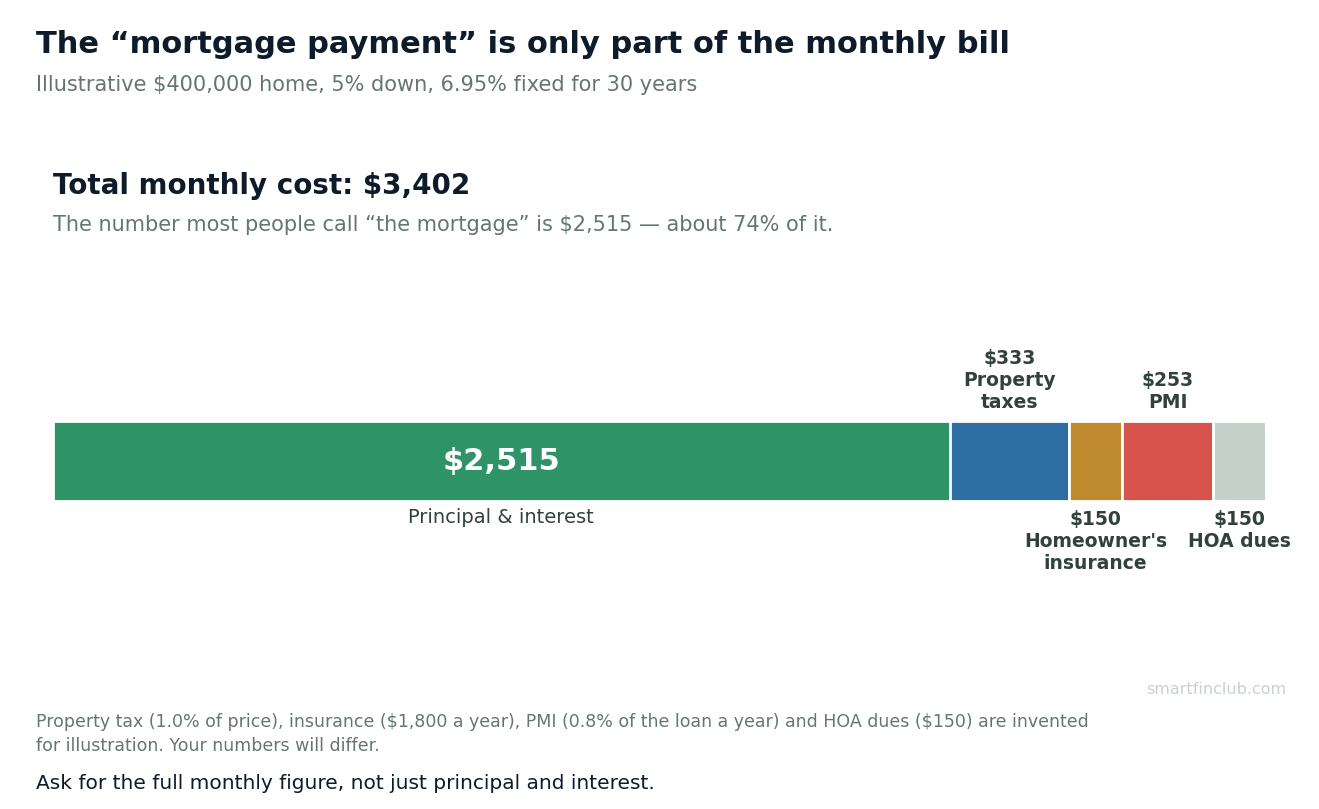
PITI stands for principal, interest, taxes and insurance. The Consumer Financial Protection Bureau calls these the four basic elements of a monthly mortgage payment. On our example home, principal and interest come to about $2,515. Property taxes and homeowner's insurance add about $483 more.
Escrow is the account your lender uses to collect a slice of your taxes and insurance every month and pay those bills for you when they come due. It smooths out the big annual bills, and it means your payment can change even on a fixed-rate loan when taxes or insurance change.
PMI, private mortgage insurance, protects the lender, not you, when a conventional loan starts with less than 20% down. On our example it adds roughly $253 a month, assuming a price of 0.8% of the loan per year. The real price depends on your credit score and down payment. The good news is that it is not permanent on most conventional loans; our article on the 80% and 78% rules explains how to end it.
HOA stands for homeowners association, an organization that manages shared expenses and maintenance in a planned community or condominium. Dues are a monthly cost that lenders count against you. To feel the size of a $350 monthly fee, know that it costs the same each month as roughly $52,874 of extra mortgage at today's rate. A condo with high dues is a more expensive home than its price suggests.
Put the pieces together and the gap is clear. Principal and interest of $2,515 is only part of the $3,402 total. The other $887 a month, or $10,640 a year, comes from taxes, insurance, PMI and HOA dues. So when anyone quotes you a “payment,” ask which of these pieces it includes.
What is this loan really costing me?
Interest rate is the yearly cost of borrowing the money, expressed as a percentage. APR, the annual percentage rate, is broader. The CFPB says it reflects the interest rate plus points, mortgage broker fees and other charges you pay to get the loan, which is why the APR is usually higher than the rate.
Here is why that matters. Take two $360,000 loans, each with $2,400 of other costs. Loan X has a 6.95% rate and no points, and a payment of $2,383. Loan Y has a 6.50% rate and two points, and a payment of $2,275. The APRs are about 7.02% for X and 6.76% for Y, so Y looks cheaper. But two points cost $7,200 at closing, and a point is simply 1% of the loan amount. Y saves $108 a month, so the points take about 5.6 years to pay off. If you sell or refinance in three years, X was the cheaper loan. APR assumes you keep the loan for its full term, and most people do not.
The practical rule. Use APR to compare loans with similar structures, and then ask how long you plan to keep the loan. On the Loan Estimate, the rate is on page 1 and the APR is in the Comparisons section on page 3.
Two more terms decide whether the rate you were quoted is the rate you get. A fixed-rate loan keeps the same interest rate for its whole term, so principal and interest never change. An adjustable-rate loan starts with a rate that can change later, and your payment can change with it. If a lender offers one, ask how long the starting rate lasts, how much the rate can rise at each adjustment and what the highest possible payment would be. A rate lock is a lender's commitment to hold a quoted rate for a set period while your loan is processed. Ask how long it lasts and what happens if closing slips past the end date.
What do I owe at closing?
Closing costs are everything you pay to finalize the loan and transfer the home: lender charges, appraisal, title work, recording fees and prepaid items. Freddie Mac says to expect between 2% and 5% of the purchase price, which on $400,000 is $8,000 to $20,000.
Earnest money is a good-faith deposit you put down when the seller accepts your offer. It is held by the seller or a third party until closing or until the contract ends, and it usually counts toward your cash to close. It is also money at risk if you miss a deadline in the contract.
Loan Estimate is the three-page form a lender must give you after you apply, and it is your tool for comparing lenders. Closing Disclosure is the five-page form with the final numbers. Lenders must give it to you three business days before your scheduled closing, and that window exists so you can hold it up against your Loan Estimate and ask about differences. In this business, people call it the CD. One more coincidence: CD also means certificate of deposit, the savings product many buyers park a down payment in while they search.
Discount points are fees you pay up front to lower the rate. The CFPB describes one point as 1% of the loan amount. The opposite trade also exists: a lender credit lowers your closing costs in exchange for a higher rate. Neither is good or bad on its own. The question is always how long you will keep the loan, which is why the break-even point in the example above matters more than the rate alone.
A five-minute way to compare two Loan Estimates
- Start with the interest rate and the monthly payment, and check whether the payment includes escrow for taxes and insurance.
- Look at the cash you would need to bring to closing, not only the rate. A lower rate can come with higher upfront costs.
- Check for points and lender credits, and ask whether a lower rate is being bought with points.
- Compare the APRs, and then ask yourself the break-even question from the example above.
- Ask each lender to explain any difference you cannot account for.
Will a lender approve me?
Prequalification and preapproval are both letters that say how much a lender might lend. The CFPB says prequalification generally relies on information you provide, while preapproval is based on verified information, but lenders use the terms differently and neither is a guaranteed loan offer. Ask what checking was done, and ask a local agent whether sellers in your area take the letter seriously.
Debt-to-income ratio, or DTI, is your monthly debt payments divided by your gross monthly income. A lender adds your future housing payment to your debts and looks at the total. Loan-to-value, or LTV, compares the loan to the home's appraised value. A $380,000 loan on a $400,000 home is 95% LTV, and higher LTVs generally mean mortgage insurance. Appraisal is the independent estimate of value the lender orders to make sure the home is worth what you are borrowing against.
To see how DTI works, suppose you earn $10,000 a month before taxes and have $500 a month in other debt payments. Add the $3,402 housing payment from our example and your debts total $3,902 a month, which is about 39% of your income. Lenders set their own limits, and they differ by loan program, so ask what applies to yours.
What can let me walk away?
A contingency is a condition written into the purchase contract that must be met for you to be bound. The common ones cover the home inspection, the financing and the appraisal. Waiving a contingency can make an offer more attractive, and it also removes your safety net. Decide with your eyes open, and with the deadline dates on your calendar.
Homeowner's insurance covers damage to the home and is required by nearly every lender. It is separate from title insurance, which protects against problems with who legally owns the property, and from flood insurance, which standard policies generally do not include. Ask early what each one costs, because insurance is often the line that surprises buyers.
None of this needs to be memorized before you start. If a word comes up that is not here, ask the person using it to explain it in dollars. And if you would like help sorting through the paperwork, reach out to a local realtor, or write to us at Info@smartfinclub.com and we will do our best to help.