Shop for a car loan and the number that matters shows up in a format everyone already understands: an APR, quoted as a percentage, directly comparable across lenders. Shop for a lease on the same car and the financing cost shows up as a money factor — a five-decimal number like .00150 that means nothing to almost anyone reading it for the first time. Both numbers describe the same thing: what you pay to finance the vehicle. Only one of them is required, by regulation, to avoid looking like it.
What a money factor actually is
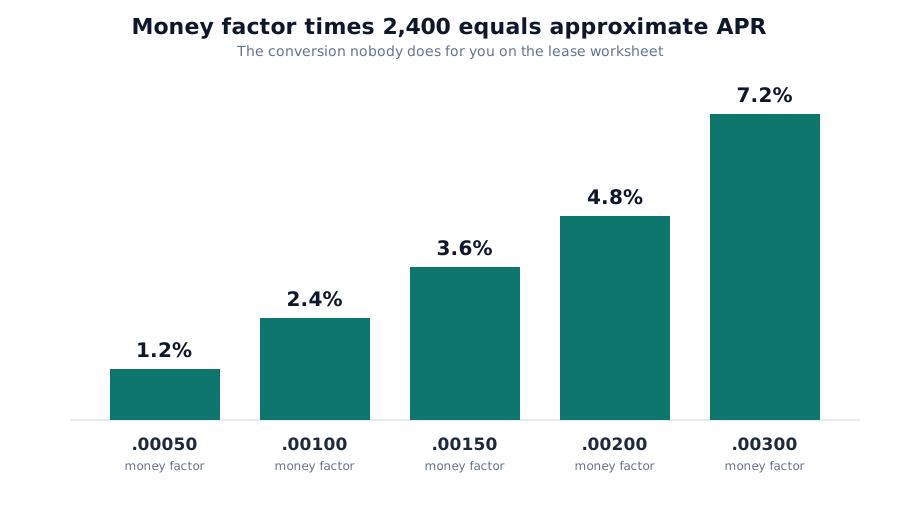
The money factor is the lease equivalent of an interest rate, expressed as a small decimal instead of a percentage. It is built into the finance piece of your monthly payment the same way an interest rate is built into a loan payment. The formula behind it: money factor equals the total lease finance charge divided by the sum of the capitalized cost and the residual value, divided again by the number of months in the term. You will not calculate it yourself — the leasing company hands it to you as a finished number — but you can convert it into something you already understand: multiply the money factor by 2,400 to get its approximate equivalent APR. A money factor of .00150 works out to roughly 3.6%. A money factor of .00300 is roughly 7.2%. The conversion is simple. The reason dealers rarely offer to do it for you is the more interesting part.
The math behind the monthly payment
A lease payment has two pieces, and only one of them involves the money factor. The depreciation fee is the vehicle's projected loss in value over the lease, spread evenly across the term: the capitalized cost minus the residual value, divided by the number of months. The rent charge is the finance piece: the capitalized cost plus the residual value, multiplied by the money factor. Add them together and you have the payment before tax.
| Item | Amount |
|---|---|
| Capitalized cost (negotiated price + fees) | $42,000 |
| Residual value (57% of MSRP after 36 months) | $24,000 |
| Money factor | .00150 (≈ 3.6% APR-equivalent) |
| Depreciation fee: ($42,000 − $24,000) ÷ 36 | $500/mo |
| Rent charge: ($42,000 + $24,000) × .00150 | $99/mo |
| Payment before tax | $599/mo |
Nothing in that monthly payment quote tells you the $99 rent charge is equivalent to financing at roughly 3.6% APR. It just arrives folded into a single number, and the money factor that produced it is often disclosed only in the fine print of the lease worksheet, if it is disclosed as a decimal at all.
Why the decimal format survives, and what "reserve" hides in it
This is not just custom. Federal Reserve Regulation M, which governs consumer lease disclosures, requires a lessor to disclose the rent charge as a line item — but it specifically bars the lessor from labeling any percentage rate in that disclosure as an "annual percentage rate," an "annual lease rate," or any equivalent term. A lease worksheet is legally discouraged from presenting its financing cost the way a loan does. That single rule is most of the reason the money factor persists in decimal form: converting it to a percentage on the disclosure itself is the one thing the format is built to avoid.
Inside that decimal sits a markup most shoppers never ask about. Captive finance arms (the manufacturer's own leasing bank) set a base money factor, called the buy rate, according to the lessee's credit tier — conceptually identical to a loan's buy rate. Dealers are typically permitted to mark that buy rate up by a capped amount, often in the range of two to three hundredths of a cent when converted, and keep the difference as compensation. Because the number is a decimal nobody has intuition for, a markup of .00050 on this same lease adds $33 a month to the rent charge — about $1,188 in extra finance charges over the 36-month term — is far harder to spot than the equivalent quarter-point bump on a loan APR would be.
Cap cost, cap cost reduction, and the down payment trap
The capitalized cost is the lease's version of the amount financed: the negotiated price of the vehicle plus fees rolled in. A cap cost reduction — a down payment, trade-in equity, or manufacturer rebate applied at signing — lowers the capitalized cost, which lowers both the depreciation fee and the rent charge. It looks exactly like putting money down on a loan. It does not behave like it.
If the vehicle is stolen or totaled early in the lease, gap insurance typically covers the difference between what you still owe the leasing company and the insurance payout. It does not typically reimburse the cap cost reduction you paid at signing — that money is simply gone, because you never owned equity in the vehicle the way a loan borrower does. A large down payment on a lease concentrates risk in the one place a total loss doesn't cover. The standard advice from lease specialists follows directly from this: negotiate the price of the car and the money factor, put down only what a lease requires (the first month's payment and fees), and treat "zero down" as the safer structure rather than a marketing gimmick.
Residual value: the number that quietly sets your buyout price
The residual value is the leasing company's projection of what the car will be worth at the end of the term, usually expressed as a percentage of MSRP. It matters twice. A higher residual lowers your monthly payment, because there is less projected depreciation to spread across the term. It also becomes your purchase option price if you decide to buy the car at lease-end, regardless of what it is actually worth by then.
Because residual value is a forecast set by the manufacturer's captive lender rather than a market outcome, some of the most attractive advertised lease deals are not low-money-factor deals at all — they are inflated-residual deals, where the manufacturer absorbs the risk that the car will be worth less than projected in order to move inventory. The advertised payment can look identical to a genuinely cheap money factor while resting on a completely different mechanism, which is one more reason the sticker payment alone tells you very little.
The number to ask for. You are entitled to ask for the money factor as a decimal, the capitalized cost, and the residual value separately — a lessor cannot legally hand you an APR on the disclosure, but nothing stops you from asking for the money factor and doing the multiplication by 2,400 yourself before you sign.