The math that gets a deal signed
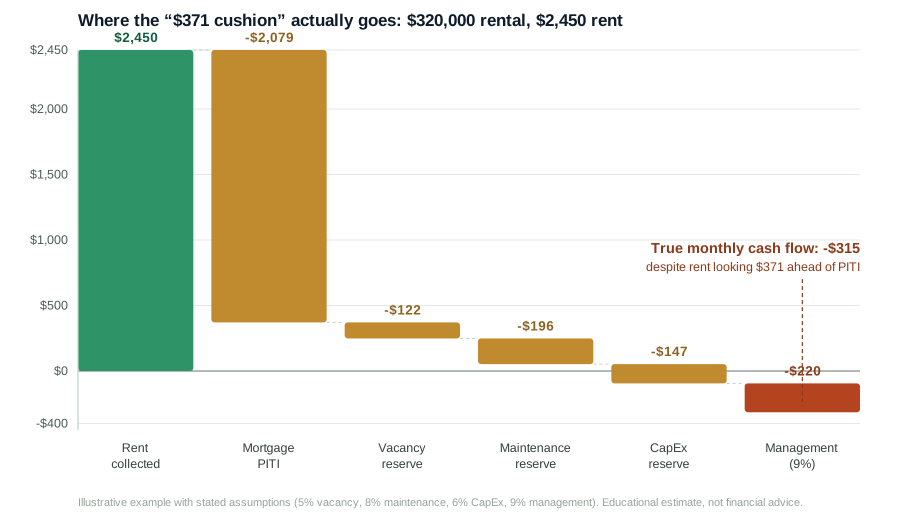
Here is the conversation that happens at a lot of kitchen tables. A $320,000 rental, 20% down, a $256,000 loan at 6.75% over 30 years. Principal and interest run about $1,660 a month. Add roughly $293 for property taxes and $125 for insurance, and the full PITI payment lands at about $2,079. The listing says the unit rents for $2,450. Subtract one from the other and the number that gets written on a napkin is +$371 a month. That napkin math is where a lot of first rental purchases get decided, and it is also where a lot of them go wrong.
PITI is a mortgage payment, not an operating budget. It answers "can I make the bank payment," not "is this a profitable business." Those are different questions, and the gap between them is exactly the reserve categories the napkin never had a line for.
What P-I-T-I leaves out of the sentence
A rental has at least four recurring costs that never show up on a mortgage statement, because a lender does not care about them and a listing agent has no reason to volunteer them:
Vacancy. No unit is rented 365 days a year forever. Tenants move, units turn over, and turnover takes time to re-list, show and re-lease. Planning for roughly 5% of gross rent as a vacancy reserve is a common, conservative starting point for a stable single-family rental in a normal market — more in a market with high turnover, less in one with long average tenancies.
Maintenance. Faucets, water heaters, paint, pest control, appliance repairs. An 8%-of-rent reserve is a widely used planning figure for a property in reasonable condition; an older property or one with deferred maintenance from the previous owner should budget meaningfully higher.
CapEx (capital expenditure reserve). Roofs, HVAC systems, water heaters and major systems do not fail evenly — they fail all at once, usually a decade or more into ownership, in a single five-figure bill. A 6%-of-rent reserve, set aside monthly and left untouched until the day the furnace actually dies, is what keeps that bill from becoming a surprise instead of a plan.
Property management. Whether an owner pays roughly 8–10% of collected rent to a management company or manages the property personally, the function still has to happen: marketing the unit, screening tenants, collecting rent, coordinating repairs, handling the 11pm call about a leaking pipe. The next section covers why doing it yourself does not make this line disappear.
What the “$371 cushion” is quietly supposed to cover. On $2,450 in monthly rent, a 5% vacancy reserve is about $123, an 8% maintenance reserve is about $196, a 6% CapEx reserve is about $147, and a 9% management allowance is about $221. That is roughly $686 a month in real, recurring costs the napkin math never mentioned — almost double the $371 that looked like the profit.
Why self-managing does not make the line items disappear
A common response to that chart is "I'll just manage it myself and skip the management fee." That removes one line item from the spreadsheet, but it does not remove the work: showings still take evenings, tenant screening still takes hours, and the plumbing emergency still happens at a bad time. The owner's own hours have a value even when no invoice gets sent for them, and the day that owner wants to sell, refinance, or simply stop being on call, the true cost of that role reappears immediately. Self-management can be a reasonable choice; treating it as a way to make 9% of rent vanish from the economics of the property is not the same thing as actually eliminating the cost.
The same logic applies to skipping the maintenance and CapEx reserves rather than the management fee. Not setting money aside for a roof does not mean the roof will not need replacing. It only means the bill arrives as a surprise instead of as a plan.
The 1% rule is a screening question, not a green light
A popular shorthand in rental real estate is the "1% rule": monthly rent should be at least 1% of the purchase price. On the $320,000 property above, that would mean $3,200 a month in rent, not $2,450 — this deal is already below the 1% threshold at 0.77%, which is itself a signal worth noticing before the PITI math even starts.
But clearing 1% is not proof of profitability either. Run the same reserve percentages against a property renting at exactly 1% and the vacancy, maintenance, CapEx and management reserves are still real costs; they simply have more room to be absorbed. The 1% rule is useful as a fast first filter to decide whether a deal is worth spending fifteen minutes modeling in full. It was never designed to replace that modeling, and a deal that passes it can still lose money once every cost is counted.
What to actually pencil out before signing anything
Before treating "rent minus PITI" as a green light, it is worth running the property's own numbers rather than generic percentages: the seller's actual repair and vacancy history where it is available, an inspector's estimate of the remaining useful life of the roof, HVAC and water heater, an actual property-management quote for the local market even if the plan is to self-manage, an insurance quote for a non-owner-occupied policy rather than a homeowner estimate, and — if the loan is anything other than a fixed rate — what the payment looks like after a rate reset. None of that requires special software; it requires treating the reserve categories in this article as real budget lines rather than the fine print.