Every dollar sitting in a traditional IRA or 401(k) has an unpaid tax bill attached to it. Eventually the IRS collects that bill — either when required minimum distributions force the money out at whatever rate applies to you that year, or from whoever inherits the account after you. A Roth conversion is the only way to move that bill to a year and a rate you pick yourself, on purpose, instead of one chosen for you later.
What actually happens when you convert
Converting means moving money from a traditional (pre-tax) IRA or 401(k) into a Roth IRA. The amount you convert is added to your ordinary taxable income for the year, exactly like a bonus or extra wages would be — there is no special conversion tax rate. In exchange, that money now grows tax-free permanently, and qualified withdrawals in retirement owe nothing.
The detail that surprises people: unlike a Roth IRA contribution, which phases out once your income crosses a threshold, a Roth conversion has no income limit at all. That gap is exactly why the “backdoor Roth” exists — a high earner makes a nondeductible contribution to a traditional IRA, then immediately converts it, arriving at a Roth despite being locked out of contributing to one directly.
One mechanical detail decides whether a conversion is worth doing at all: pay the resulting tax from money outside the IRA, not by withholding it from the conversion itself. Withhold $2,448 from a $20,400 conversion and only $17,952 actually reaches the Roth — and if you are under 59½, the withheld amount is treated as a distribution and can trigger its own 10% penalty on top. Paying the bill from a checking or savings account is what makes the whole trade work.
The strategy is filling the bracket, not avoiding it
Because a conversion is voluntary income, the only real question is which bracket's remaining room you are filling. Each bracket taxes only the income inside it, so the goal is to convert exactly up to the top of your current bracket and stop — not to round to a number that feels significant.
Take a single filer in a low-income year — early retirement before Social Security starts, a sabbatical, a year between jobs — with $30,000 of taxable income after deductions. For 2026, the 12% bracket runs from $12,400 to $50,400, so there is $20,400 of room left in it before the next dollar spills into the 22% bracket.
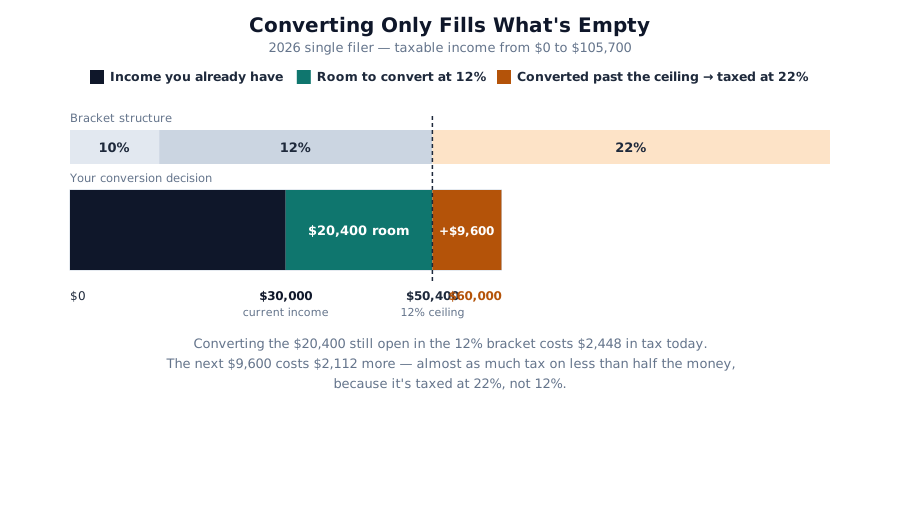
Converting the full $20,400 costs $2,448, payable the following April, in exchange for that money never being taxed again. Convert past $50,400 instead, and the excess is taxed at 22% rather than 12% — the bracket does not care that you meant to stop at a round number, only where the ceiling actually sits.
Married couples filing jointly work the same way against wider thresholds: the 2026 joint 12% bracket runs to $100,800, roughly double the single-filer ceiling, alongside a larger standard deduction. The mechanics do not change — find the top of the current bracket, subtract current taxable income, and that difference is the room available this year.
Because the room resets every January 1, most people who use this strategy seriously do it as a multi-year ladder rather than one large conversion: fill the cheap bracket every year for as long as income stays low, rather than converting a decade's worth of deferred savings in a single year and pushing much of it into brackets far above 12% or 22%.
The rule that stops you from cherry-picking your basis
If you have ever made a nondeductible (after-tax) contribution to a traditional IRA, you might assume you can convert just that after-tax slice and leave the pre-tax money untouched. The IRS does not allow it. Under the pro-rata rule (IRC §408(d)(2), tracked on Form 8606), every traditional IRA you own is treated as a single combined account for conversion purposes — the nontaxable share of any conversion is your total basis divided by the year-end value of all your traditional IRAs, not just the one you converted from.
This is the rule that quietly breaks backdoor Roth conversions: someone makes a nondeductible contribution, converts it, and assumes it is tax-free — forgetting an old rollover IRA sitting elsewhere with $80,000 of pre-tax money in it. That balance gets pulled into the same pro-rata calculation whether they meant it to or not.
One narrower piece of good news: the pro-rata calculation is done per individual, not per household. A spouse's traditional IRA balance has no effect on your own conversion's taxable share, even on a joint return — only the IRAs in your own name are added together.
You cannot take it back
Before 2018, a conversion could be undone through recharacterization — useful if the market dropped afterward and you had paid tax on a balance that no longer existed. The Tax Cuts and Jobs Act eliminated that option for any conversion made in 2018 or later. A conversion today is final the moment it settles, which means the amount has to be right when you choose it, not something to correct after the fact.
The five-year rule nobody mentions until it costs them
Here is the part that catches even careful planners: each conversion carries its own five-year clock, separate from any other Roth clock you may have already satisfied — and that clock applies to the already-taxed converted principal itself, not to any earnings. Withdraw converted money before that conversion's five years are up, and before you turn 59½, and the IRS charges a 10% penalty on the full converted amount — money you already paid ordinary income tax on the year you converted it.
That is different from the separate, once-per-lifetime five-year rule that determines whether earnings come out tax-free, which starts with your very first Roth IRA. Satisfying one clock does not satisfy the other, and a large early withdrawal can trigger the conversion penalty even from an account that has technically existed for years.
Two more numbers worth knowing before you convert
No required minimum distributions. A Roth IRA has never had RMDs for the original owner, and since SECURE 2.0 took effect in 2024, Roth 401(k)s do not either. Converted money never forces itself out on the IRS's schedule — it can keep compounding, or pass to heirs, on yours.
IRMAA, if Medicare is close. Medicare Part B and Part D premiums are recalculated off a tax return from two years earlier. A large conversion at 63 can mean a higher Medicare premium at 65, even though the conversion itself has nothing to do with health coverage. Anyone converting a large amount within two years of enrolling in Medicare should run that number before signing off.
Nobody sends you a bill for a Roth conversion. You write it yourself, for an amount you chose, in a year you chose — and once it is filed, there is no recharacterization to undo it. The alternative is a bill someone else writes later, on money you no longer control the timing of, at whatever rate happens to be in force when the IRS or your heirs finally collect it.