Ask a seller what they made on a house and you will get one subtraction: what it sold for, minus what was left on the mortgage. It is the natural way to think about it and it is wrong by a margin large enough to change decisions — whether to sell at all, whether you can afford the next down payment, whether that kitchen was worth doing.
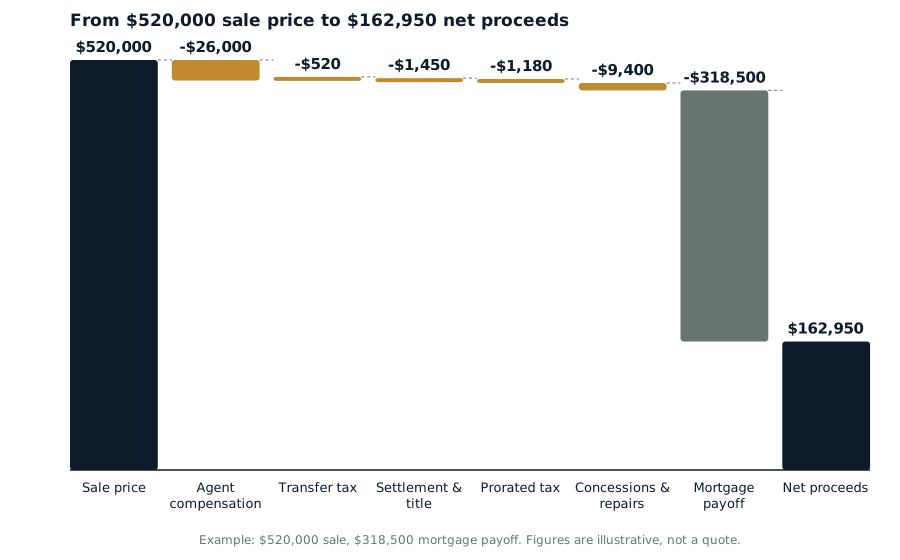
Below is a sale we will use throughout: $520,000 contract price, $318,500 left on the loan. The mental arithmetic gives $201,500. The wire that arrives a few days after closing is $162,950. Here is where the other $38,550 went, in the order it comes off the settlement statement.
Agent compensation, which is genuinely negotiable now
This is the largest line, and it is the one where the industry's own ground shifted recently. As of 17 August 2024, under the National Association of Realtors practice changes, offers of compensation to a buyer's agent can no longer be published on the MLS. Sellers can still offer compensation outside the MLS, and can still offer buyer closing-cost concessions within it. NAR's own material is blunt on the underlying point: compensation “continues to be fully negotiable” and broker fees are “not set by law.”
We are deliberately not printing a standard rate here, because there isn't one, and quoting the old rule of thumb as though it were a fact is part of how sellers end up surprised. In our example we have used 2.5% on each side, $13,000 apiece, $26,000 in total — because you have to put something in a worked example, not because that is what you should pay. Ask what you are being charged, ask what it buys, and put the number you actually agree into your own arithmetic.
Transfer tax, which is small and easy to forget
Virginia's grantor's tax is set by statute at 50 cents per $500 of the sale price — $1 per $1,000, or 0.1%. On $520,000 that is $520. It is nominally the seller's, though the code expressly allows the parties to agree that the buyer pays part or all of it.
Two regions add to it. Northern Virginia carries a regional congestion relief fee of $0.10 per $100, and Hampton Roads a regional transportation improvement fee of $0.06 per $100. Most of the rest of the state, the Richmond area included, does not. If you are outside Virginia, this line will look completely different — some states charge many times more, a few charge nothing, and a handful put it on the buyer — so check your own before assuming it is a rounding error.
Settlement, title and the small administrative pile
Deed preparation, the settlement agent's fee, the wire fee, recording, a courier or two. Individually trivial, collectively a four-figure line on most closings. We have used $1,450. It is not usually worth negotiating, but it is worth knowing it exists, because it is the line most often absent from a seller's own estimate.
Prorated property tax, which surprises people in both directions
You owe property tax for the portion of the tax year you owned the house. Depending on your locality's billing cycle and closing date, this appears as a debit or a credit. In our example it is $1,180 out. Sell just after paying a semi-annual bill and it can come back to you instead. This is arithmetic, not negotiation, and your settlement agent will get it right — the point is only that you should not budget as though it were zero.
Concessions and repairs, the two lines that move most
These are the ones that turn a clean-looking deal into a disappointing one. A buyer asks for $6,000 toward closing costs and you agree, because agreeing is cheaper than relisting. The inspection finds a water heater at the end of its life and some grading against the foundation, and you credit $3,400 rather than argue. Neither shows up in the sale price. Both come straight off your proceeds.
Worth saying plainly: the headline price you tell people you sold for can be entirely real while $9,400 of it never belonged to you. If you are comparing your outcome to a neighbour's, you are almost certainly comparing two numbers that were measured differently.
The payoff is not your balance
The last and largest line is the mortgage payoff, and it is not the balance on your last statement. A payoff quote is the principal plus interest accrued to the actual payoff date — interest is charged per diem — plus any recording or release fee, plus a prepayment charge if your note has one (uncommon on residential loans now, but not unheard of). It is typically a few hundred dollars more than the statement figure, and it expires, which is why the settlement agent orders a fresh one.
The pattern worth remembering. Of the $38,550 gap in this example, $26,000 was negotiable, $9,400 was conceded during the deal, and about $3,150 was tax, fees and per-diem interest that were never going to be avoidable. The negotiable and the conceded are, together, more than 90% of it — which is a more useful thing to know than the total.
What does not come off, and what people wrongly add
Two categories cause confusion in the other direction.
Money you spent before closing is not on the settlement statement. Staging, painting, the pre-listing repairs, the storage unit, two extra mortgage payments while the house sat — all real, all already gone, none of it visible in the net figure. If you are judging whether the sale went well, those belong in your own arithmetic even though the closing table never mentions them.
Improvements do not reduce your proceeds, but they do matter later. The kitchen you put in five years ago does nothing to this calculation. It raises your adjusted basis, which reduces your taxable gain, which is a different calculation entirely. Keep the receipts; they are worth more to you in April than they were at closing.
Build the net sheet before you list, not after
A good agent will hand you a seller's net sheet, and you should ask for one at the listing appointment rather than at the closing table. Doing your own alongside it is not a lack of trust; it is how you find the line you did not know about while there is still time to plan around it. The seller net proceeds calculator takes the price, the payoff, each cost line and the closing date, and gives you a figure you can put next to theirs.
Two other things belong in the same sitting. The first is tax: your proceeds and your taxable gain are different calculations that share almost no inputs, and a sale can produce a modest wire and a large tax bill or the reverse. The home sale capital gains calculator handles that side. The second is what the proceeds actually have to do: if they are the down payment on the next house, run them through the home affordability calculator before you fall in love with a listing.
One last note in the interest of honesty about our own limits: we are not your settlement agent, your broker or your accountant, and a net sheet built from assumptions is a planning tool, not a promise. The settlement statement governs. What a net sheet buys you is the absence of surprise, which on a transaction this size is worth the twenty minutes.