The sentence that gets copied everywhere
Search for SEP-IRA contribution limits and the answer that comes back is nearly always some version of "the lesser of 25% of compensation or the annual dollar cap." For 2026 that dollar cap is $72,000. For a W-2 employee of someone else's company, the 25% figure is straightforward: it applies to actual W-2 wages, and the math is exactly what it looks like.
For a sole proprietor — someone filing a Schedule C with no employees — "compensation" is not net profit, and the 25% does not apply the way it reads. Following the IRS's own worksheet produces a different, lower effective rate, and the difference is not a rounding error.
Why the self-employed math is not simply 25% of profit
A self-employed person's plan contribution is legally defined as 25% of "net earnings from self-employment," which is itself defined as net profit, reduced first by the deduction for one-half of self-employment tax, and then reduced again by the retirement contribution itself. That last part makes it circular: the contribution is defined in terms of a number that already has the contribution subtracted from it.
Solving that circular definition algebraically is standard IRS worksheet math, and it produces a clean result: a contribution equal to 25% of compensation-after-the-contribution is mathematically the same as a contribution equal to 20% of compensation-before-the-contribution. That 20% is what actually gets applied to net earnings from self-employment, after subtracting half of self-employment tax — not to raw net profit, and not at a 25% rate.
Working an actual number: $150,000 in net profit
Start with $150,000 in net Schedule C profit for 2026. Net earnings from self-employment are calculated as 92.35% of that figure, or about $138,525. Self-employment tax on that amount, at the combined 15.3% rate below the Social Security wage base, is about $21,194. Half of that tax, about $10,597, is deducted first, leaving an adjusted net-earnings base of about $127,928. Twenty percent of that base is the actual maximum SEP-IRA contribution: about $25,586.
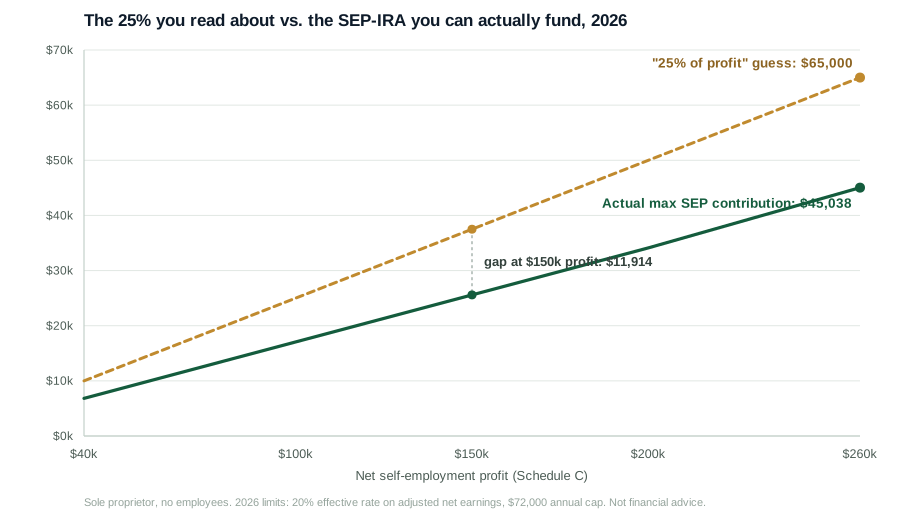
Compare that to the number a lot of people write down first — 25% of the original $150,000 profit, or $37,500. The real, IRS-worksheet-calculated maximum is almost $11,914 lower than that guess. Anyone who plans a retirement contribution, or a tax deduction, around the naive 25% figure will come up short by that amount at tax time.
The gap gets wider, not narrower, as income rises
Because both lines are roughly proportional to income, the dollar gap between the 25%-of-profit guess and the actual 20%-of-adjusted-earnings limit grows as net profit grows — from about $4,766 at $60,000 in profit to nearly $20,000 at $260,000, before the $72,000 annual dollar cap eventually limits contributions regardless of the percentage math at much higher income. Higher-earning self-employed people have the most to lose from planning around the wrong percentage, not the least.
A Solo 401(k) uses the same math, with one addition
A Solo 401(k)'s employer profit-sharing contribution for a sole proprietor is limited by the identical 20%-of-adjusted-net-earnings calculation as a SEP-IRA — there is no separate, more generous rule on that side of a Solo 401(k). What a Solo 401(k) adds is an employee elective-deferral contribution, up to $24,500 for 2026 (plus catch-up amounts for those 50 and older), on top of the employer share. That additional deferral is what typically lets a Solo 401(k) reach a higher total contribution than a SEP-IRA at the same income, not a more favorable profit-sharing percentage.
Why an S-corp changes the answer entirely
An owner who runs their business as an S-corp and takes a W-2 salary is, for retirement-plan purposes, a common-law employee of their own corporation. The plan can contribute up to the full 25% of that actual W-2 wage, with no self-employment-tax adjustment reducing the rate to 20%. That is one of the standard reasons an S-corp election gets discussed alongside retirement planning for profitable self-employed businesses — though the S-corp decision has its own separate costs and tradeoffs well beyond retirement contributions, and is not one to make on this basis alone.