rel="icon" href="/favicon.ico" sizes="32x32">
FinTalks · Debt & Credit

The Smallest Payment Is Usually the Most Expensive Loan

Shopping by monthly payment feels responsible — it is the number that has to fit the budget every month. It is also the easiest number for a lender to make small, by stretching the term or adding fees, while the total cost of the loan quietly grows. The same $25,000 loan can cost anywhere from about $2,750 to nearly $8,800 in interest and fees, depending only on which offer is accepted.

Four offers, one loan amount

Say a lender approves $25,000 and hands over a menu of terms rather than a single offer — which is close to how many auto and personal loans are actually sold. A 36-month term at 6.9% APR carries a payment of about $771 a month. Stretch that to 48 months at 7.5% APR and the payment drops to about $604. Stretch further, to 60 months at 8.5% APR plus a $300 fee, and the payment falls to about $513. Stretch all the way to 72 months at 9.9% APR plus a $500 fee — a combination not unusual on a "low payment" plan — and the payment drops to about $462.

Looked at only through the monthly payment, the 72-month offer looks like the easy winner: $462 versus $771 is a 40% lower payment for the same $25,000. That comparison is exactly backwards, because it never asks what all four offers actually cost.

The same four offers, by total cost

Total interest and fees tell a very different story. The 36-month loan costs about $2,748 in interest over its life. The 48-month loan costs about $4,015. The 60-month loan costs about $6,075 once its $300 fee is included. The 72-month loan costs about $8,756 once its $500 fee is included. The offer with the smallest payment costs roughly 3.2 times as much as the offer with the largest one.
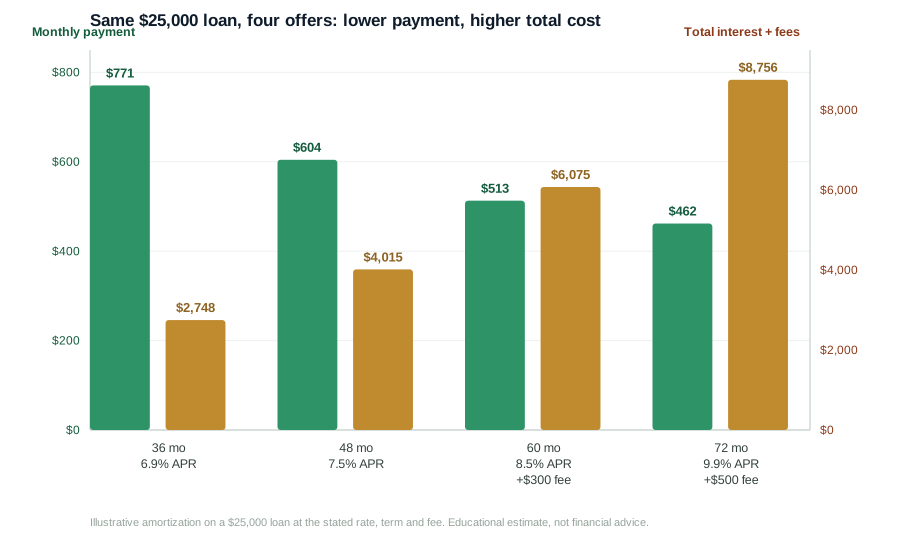
Bar chart comparing four offers on a $25,000 loan: 36 months at 6.9% APR costs $771 a month and $2,748 total interest, while 72 months at 9.9% APR plus a $500 fee costs $462 a month but $8,756 in total interest and fees
On the same $25,000 loan, the lowest monthly payment (72 months, 9.9% APR, $500 fee) costs about $8,756 in interest and fees — roughly 3.2 times the $2,748 cost of the highest-payment offer (36 months, 6.9% APR).

Why the lowest payment tends to come with the highest rate too

This is not a coincidence built into the example. A longer repayment period is more time for a borrower's income, health, or circumstances to change, and lenders price that added uncertainty into the rate. So stretching a term to lower the payment usually raises the rate at the same time, and the two effects compound: more months at a higher rate on a balance that pays down more slowly, because more of each smaller payment is interest rather than principal in the early years.

Where the extra $6,008 goes. Between the 36-month offer and the 72-month offer, total interest and fees rise by about $6,008 — almost a quarter of the original loan amount — in exchange for a payment that is $309 a month lower. That trade may still make sense for a borrower who genuinely cannot carry the higher payment, but it should be a decision made with the $6,008 in view, not a decision made by looking at the payment alone.

Fees hide inside "low payment" offers especially well

A financed origination or documentation fee lowers neither the payment by much nor the headline rate, but it adds directly to the total cost, and it is more common on longer-term, lower-payment offers precisely because the smaller monthly number leaves room to absorb it without the payment looking obviously different. Comparing offers on APR — which folds financed fees into a single effective annual rate — catches this in a way that comparing the stated interest rate alone does not.

What to compare instead of the payment

None of this means the payment does not matter; a payment that does not fit the budget is a real problem regardless of total cost. It means the payment should be the second number checked, not the only one. Before accepting an offer, it is worth lining up, side by side: the APR (not just the rate), the term in months, any financed fees, and the total amount that will be repaid over the life of the loan. A lower payment that comes with a materially higher total cost is a genuine trade-off worth making consciously — not a default that should be accepted because it was the smallest number on the page.

Compare your own loan offers

Every figure in this article came out of the calculator below. Enter each offer's amount, term, rate and fees to see the payment and total cost side by side.

Loan Comparison Calculator Amortization Schedule Browse all 50 calculators

Common questions

Is a longer loan term ever the right choice?

It can be, if the lower payment funds something with a higher return or protects a genuinely tight budget from default risk. The point is not that longer terms are always wrong, it is that the total cost should be compared before choosing, not just the payment.

Why do longer loan terms usually come with higher rates too?

Lenders view a longer repayment period as more exposure to the borrower's circumstances changing, and price that added risk into the rate. The result is that stretching the term to lower the payment often raises the rate as well, compounding the total cost increase.

How do fees affect the comparison?

An origination or documentation fee added to a lower-rate, longer-term offer can erase some or all of its apparent advantage. Comparing offers on APR, which folds financed fees into an effective annual rate, is more reliable than comparing the stated interest rate alone.

What is the single best number to compare across loan offers?

Total amount repaid over the life of the loan, including all interest and financed fees. Monthly payment answers whether the loan fits this month's budget; total cost answers what the loan actually costs.

Not financial advice. This article is general educational information and nothing in it is financial, investment, tax, legal, accounting or insurance advice, a recommendation of any product, lender, plan, adviser or provider, or an offer of any kind. It does not take your circumstances into account, and reading it creates no advisory or fiduciary relationship. The rates, terms and fees used here are illustrative; actual offers vary by lender, credit profile and loan type. Confirm anything you intend to act on with the lender making the actual offer, and consult a licensed financial adviser or credit counselor for guidance specific to your situation.

See the full Financial Disclaimer and Terms of Use.

SmartFinClub Editorial · Published 13 September 2026 · SmartFinClub, Glen Allen, Virginia. Comments or questions are welcome — send them to Info@smartfinclub.com and we will read every one. If you spot an error or would particularly like to hear about it, corrections get made and credited.

← All FinTalks articles