Time-sensitive, written September 21, 2026. The Department of Education raised the autopay interest-rate discount to 1.0% for Direct Loans and says borrowers must enroll by 11:59 p.m. ET on September 30, 2026 to receive it. If you read this after that date, check studentaid.gov for the current terms. Rules for student loans have been changing, so confirm everything here with the Department of Education or your loan servicer.
If you borrowed for college, you have likely noticed the news: repayment plans have been renamed, ended or replaced. This article covers the changes that most affect what you pay, and separates the things you can control from the things you cannot.
What your loan costs this year
Federal Direct Loan interest rates are set each year for loans first disbursed between July 1 and June 30. For 2026-27, the rate is 6.52% for undergraduate loans, 8.07% for graduate and professional unsubsidized loans and 9.07% for Parent PLUS and Grad PLUS loans. For 2025-26 the rates were 6.39%, 7.94% and 8.94%. Rates are fixed for the life of each loan, so your rate depends on when each loan was first disbursed.
The repayment plans
For loans made on or after July 1, 2026, there are two repayment plans: a Tiered Standard plan with fixed payments over 10, 15, 20 or 25 years depending on how much you owe, and the Repayment Assistance Plan, or RAP. The old SAVE plan has ended, and borrowers who were in it are being moved to other plans. The Department says PAYE and ICR are being phased out, and borrowers with older loans must choose RAP, Tiered Standard or Income-Based Repayment by July 1, 2028.
RAP is the income-driven option. Payments are set as a share of adjusted gross income, from 1% to 10%. For example, income of $10,001 to $20,000 is 1%, $20,001 to $30,000 is 2% and $30,001 to $40,000 is 3%, rising to 10% for income above $100,000. Someone with an income of $35,000 would owe about $88 a month, or $38 with one dependent, since the plan reduces the payment by $50 per dependent. Compare that with the $190 of monthly interest on a $35,000 loan at 6.52%. Under RAP, the Department says unpaid interest is waived when you make on-time payments, so your balance does not grow, and it also adds a matching contribution to principal of up to $50 a month. Any balance left after 360 qualifying payments is forgiven.
Questions to ask before you choose a plan
Your servicer can answer these for your own loans, and it is worth asking for the answers in writing or through your online account:
- What would my monthly payment be under each plan I can choose? Compare them side by side, not one at a time.
- What is the projected payoff date and total amount paid under each? A lower payment can feel like relief, but the total cost may be higher.
- Which payments count toward the 360 payments for forgiveness under RAP? Ask how your count is tracked and where you can see it.
- What paperwork or updates does the plan require, and how often? Ask what happens if you miss a deadline.
- Which choices apply to my older loans, and by when? The Department says borrowers with older loans must choose by July 1, 2028.
Five ways to pay less
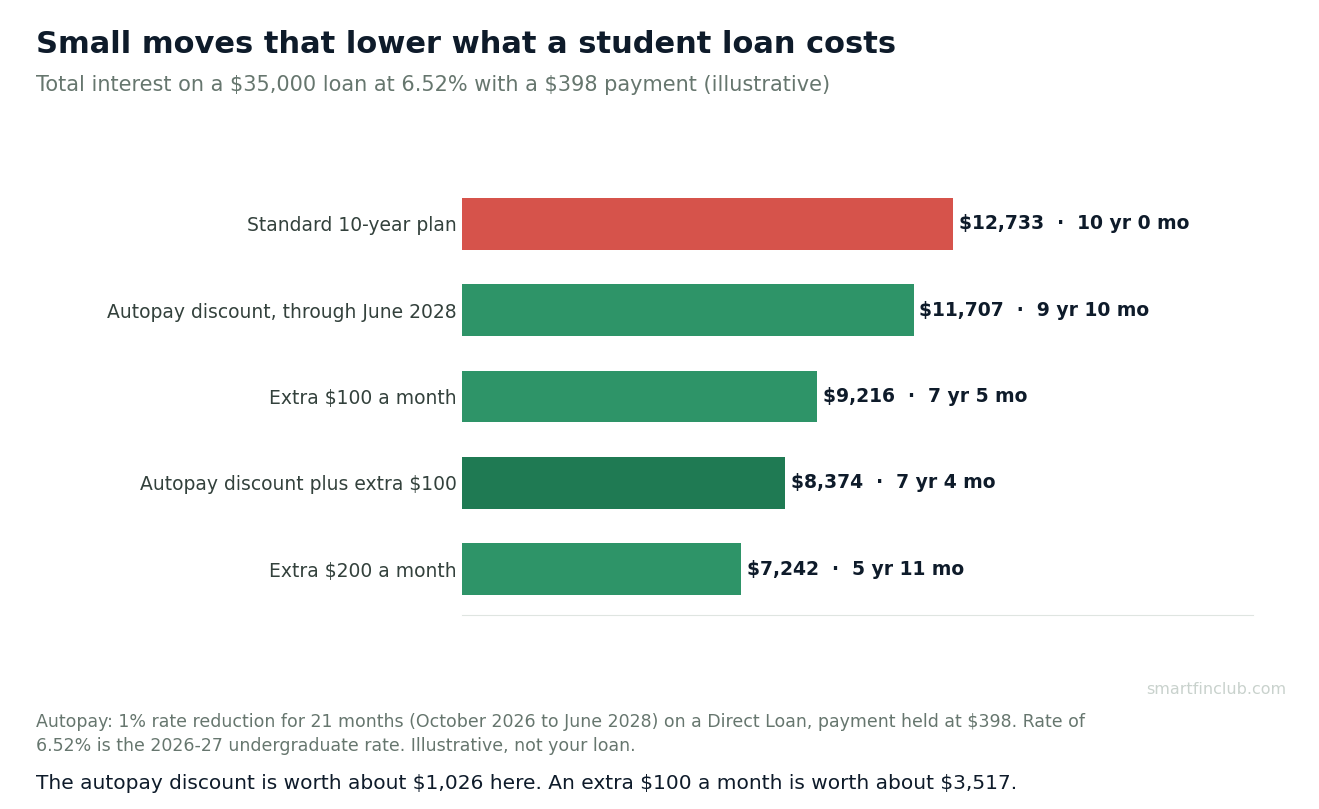
- Enroll in autopay. The discount is now 1.0%. On our $35,000 example it saves about $1,026 in interest if it lasts through June 2028, when the Department says the temporary discount ends. It is suspended during deferment or forbearance, and you can lose it if three consecutive payments are returned.
- Add a little extra. An extra $100 a month on the same loan cuts the payoff to 7 years 5 months and saves about $3,517. Both moves together save about $4,359.
- Pay the most expensive loan first. If you have several loans, send extra money to the highest rate, keeping the minimum on the rest. That is the avalanche method, and our snowball-versus-avalanche article explains it.
- Use the tax deduction if you qualify. You may be able to deduct up to $2,500 of student loan interest. The IRS phases the deduction out at higher incomes, from $85,000 to $100,000 for single filers in 2025, with the thresholds adjusted each year, so check the current figures.
- Ask your employer. Some employers help pay student loans. The IRS says up to $5,250 a year of employer educational assistance can be excluded from your income, and payments toward student loans count. Ask HR whether your employer offers it and whether it is still available.
What the autopay discount looks like month to month
On our $35,000 example, the first month of interest is about $190 at 6.52% and about $161 at 5.52%, so the discount trims roughly $29 in the first month. Because we keep the payment at $398 in the example, that saved interest goes to principal instead, and the smaller balance keeps producing small savings. In our model the loan's regular 6.52% rate applies again once the discount ends. The discount is small each month and adds up only over time, which is why it is worth setting up early. Keep enough in the account each month, because the Department says three consecutive returned payments end it. Set a calendar reminder a few days before each due date to check the balance, and do not leave enrollment for the last day of the window.
Extra payments: where the money goes
An extra payment helps only if it reaches your balance. Ask your servicer how extra money is applied, and confirm that it goes to principal on the loan you choose, not toward your next due date. If you have several loans, aim it at the highest rate. Where does $100 a month come from? Common sources are a payment on another debt that has ended, a raise or a tax refund.
Before you send extra, look at the rest of your finances. In our example each extra dollar avoids interest at 6.52%, a certain saving. But without a starter emergency fund, a surprise bill may land on a credit card, and the Federal Reserve's G.19 report puts the average card rate at 22.15% for accounts assessed interest. Our emergency fund article explains how to build a starter fund, and it usually comes before big extra loan payments.
Managing your loans day to day
- Know what you owe. Sign in at studentaid.gov to see every federal loan, its rate and its servicer. Private loans will not appear there, so gather those separately.
- Keep your contact information current. Servicers send notices about plan changes, and missing one can cost you time or money.
- Be careful with private refinancing. Refinancing federal loans with a private lender may lower your rate, but you generally give up federal repayment plans and protections. Consider that before you switch.
- Do not ignore trouble. If you cannot make a payment, contact your servicer before you miss one. Options exist, and they work best when you act early.
If you are struggling to pay
Call your servicer before you fall behind. Depending on your loans, options may include changing to a payment plan tied to your income, or a temporary deferment or forbearance. Be aware that the Department says the autopay discount is suspended during a deferment or forbearance, and a lower payment may mean your balance takes longer to fall, so ask what each option will cost you in total. The Department also now allows two loan rehabilitations for borrowers whose loans have defaulted. Acting early is far cheaper than acting late.
It helps to have a few things ready before you call: a list of your loans and their balances, your current income, a rough monthly budget and the questions above. Write down the date, the name of the person you spoke with and what they told you. If the answer surprises you, ask them to point to where it is written, and follow up in writing.
The order of operations. Enroll in autopay. Choose the plan that fits your income. Keep some emergency savings. Then send extra money to the highest-rate loan. In that order, most of the savings come from the first two steps.
We are not lenders or the Department of Education, and this area is changing quickly. Use this article to know which questions to ask, and confirm the answers at studentaid.gov or with your servicer. If you would like to talk it through, write to us at Info@smartfinclub.com.