Credit card mail and app banners love the phrase “0% APR for 18 months.” It sounds like free money: move your balance, stop paying interest, pay it down at your own pace. Most of that is true. The “free” part usually isn’t. A balance transfer can be a genuinely good move — it just isn’t the no-cost reset the ads imply, and the two things that quietly determine whether it saves you money are a fee you pay on day one and a clock that runs faster than most people plan for.
What a balance transfer actually is
A balance transfer moves debt from one credit card to another, usually a new card the issuer wants you to open. The Consumer Financial Protection Bureau describes it plainly: it “lets you move an outstanding balance from one credit card to another, sometimes for a fee,” and the promotional 0% or reduced-rate period issuers use to attract that transfer only lasts a limited time — once it ends, the rate on any remaining balance typically jumps to the card’s standard rate.
That’s the whole mechanism. The 0% period doesn’t erase the debt or shrink it; it just pauses the interest meter for a set window so more of each payment goes to principal instead of interest.
The fee you pay whether or not you save anything
Almost every balance transfer offer charges a fee to move the balance over, charged as a percentage of the amount transferred or a flat dollar minimum, whichever is larger. There’s no federal cap or standard rate for this fee — issuers set it card by card — but in practice it commonly runs 3% to 5% of the transferred balance. Treat that range as a rule of thumb to check against the specific offer, not a guaranteed number: some cards charge less to win new customers, a few (rarely) waive it during a promotion, and some charge more on cards marketed for debt consolidation specifically.
On a $6,000 balance, a 3% fee is $180; a 5% fee is $300. That fee is charged up front, added to your new balance, whether or not you end up paying off the debt before the promotional rate expires. It’s the built-in cost of the deal — the question is whether the interest you avoid is worth more than that.
The clock is shorter than the ad implies — but it can’t be too short
Federal rule sets a floor, not a ceiling, on how long a promotional rate has to last. Under Regulation Z, the rule that implements the CARD Act, a card issuer can only raise a temporary promotional rate “upon the expiration of a specified period of six months or longer” — in other words, an issuer legally cannot advertise a 0% “intro” rate and yank it away in, say, eight weeks. In practice, most 0% balance-transfer offers run well past that floor, commonly somewhere in the 12-to-21-month range, but the exact length varies by card and by your own creditworthiness, so the number on your specific offer letter is the one that matters, not an average.
What ends the 0% rate early, before the promotional period is even up? The CFPB flags one common trigger: if you fall more than 60 days behind on a payment, the issuer is allowed to raise your interest rate — potentially on your entire balance, including the transferred amount, not just the late payment. A single missed due date can undo the whole point of transferring the balance in the first place.
Running the numbers
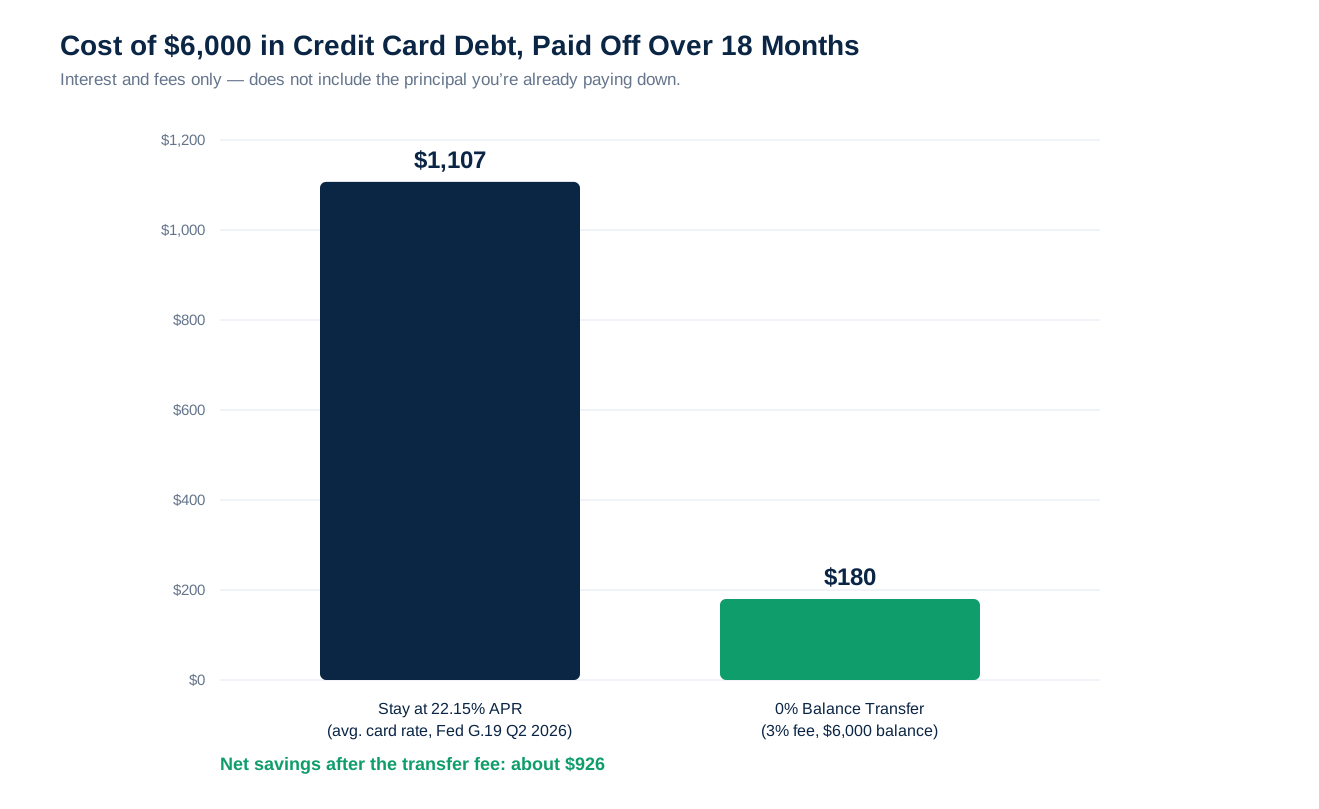
Here’s a worked example (the person and balance are invented, for illustration only — the math is real). Say you’re carrying $6,000 in credit card debt. As of the Federal Reserve’s most recent Consumer Credit (G.19) release, the average rate actually being charged on credit card accounts that carry a balance was 22.15% (Q2 2026 data, released September 8, 2026) — a reasonable stand-in for “what you’re probably paying today” if you don’t know your own card’s exact rate.
Paying that $6,000 down over 18 months at 22.15% APR, with a fixed monthly payment, costs about $1,107 in interest by the time it’s paid off (payment of roughly $395/month).
Move the same $6,000 to a card with 0% APR for 18 months and a 3% transfer fee, and the fee is $180. Paying it off over the same 18 months costs $180 total, full stop — no interest, because there isn’t any during the promotional period. That’s roughly $926 saved compared with paying it down at the average rate, even after the fee. At a 5% fee ($300), the savings are smaller but still real — about $807.
The math flips, though, if the balance isn’t cleared before the promo ends. Whatever is left starts accruing interest at the new card’s regular purchase APR, which is often higher than what you started with, not lower — card issuers who offer aggressive 0% intro periods commonly charge steep standard rates once the introductory period is over. That’s a rule of thumb worth confirming on the actual card terms, not a number this article can source to a single issuer.
Before you transfer, check these
A few things determine whether a specific offer is actually worth it, beyond the fee-versus-savings math above:
- Can you realistically pay it off inside the promotional window? Divide the balance plus the fee by the number of promo months — that’s roughly the monthly payment you’d need to owe nothing when the 0% rate ends.
- Does the new card close the old one, or leave it open? Closing old accounts can affect your credit utilization and the length of your credit history; that’s a credit-score consideration separate from the interest math.
- Is there a cap on how much you can transfer? Issuers sometimes limit the transfer to a percentage of the new card’s credit limit, so a $6,000 debt might not fully fit.
- What’s the post-promo APR, exactly? It’s printed in the card’s terms (the Schumer box), not the marketing email — read that number specifically, since it’s what you’ll pay on anything left over.
- Are new purchases included in the 0% rate, or just the transferred balance? Some cards only extend the promotional rate to the transfer itself; a new purchase on the same card can start accruing interest immediately, and payments are often applied to the lowest-rate balance first, leaving the purchase balance to accrue interest longer.
None of this makes a balance transfer a bad idea — for someone who can pay off the balance inside the promotional window, it’s usually a straightforward win, as the worked example above shows. It just isn’t the free reset the offer letter makes it sound like, and the two numbers that actually decide the outcome — the transfer fee and the number of months until the rate resets — are both printed on the offer, not the ad.
Questions about the arithmetic above, or think we got a number wrong? Write to us at Info@smartfinclub.com.