Tax planning has a reputation for being complicated, and the fancy parts often are. But a handful of moves are simple, and they share one feature: you set them up once, and they work all year. The catch is timing. A payroll deferral or a benefits election cannot be back-dated, so the fall is when the decision counts.
Read this first. As of this writing, the IRS had not published the 2027 limits for 401(k) plans and IRAs, so this article uses the 2026 limits for those and says so each time. The 2027 HSA limits are out. This is general information, not tax advice. Your situation may change what applies.
How to read the savings numbers
A deduction, or a contribution made before tax, lowers the income you are taxed on. The saving is your bracket rate times the amount, which is why the same $3,000 saves less at 12% than at 22%. A credit, such as the Saver's Credit below, reduces the tax itself. A traditional 401(k) deferral also postpones tax rather than erasing it, because you generally pay income tax when you withdraw the money. If your plan offers a Roth option, you pay tax now and get no saving this year, in exchange for different treatment later. The figures here leave out state taxes and assume traditional, pre-tax contributions.
Start now: choices tied to payroll and open enrollment
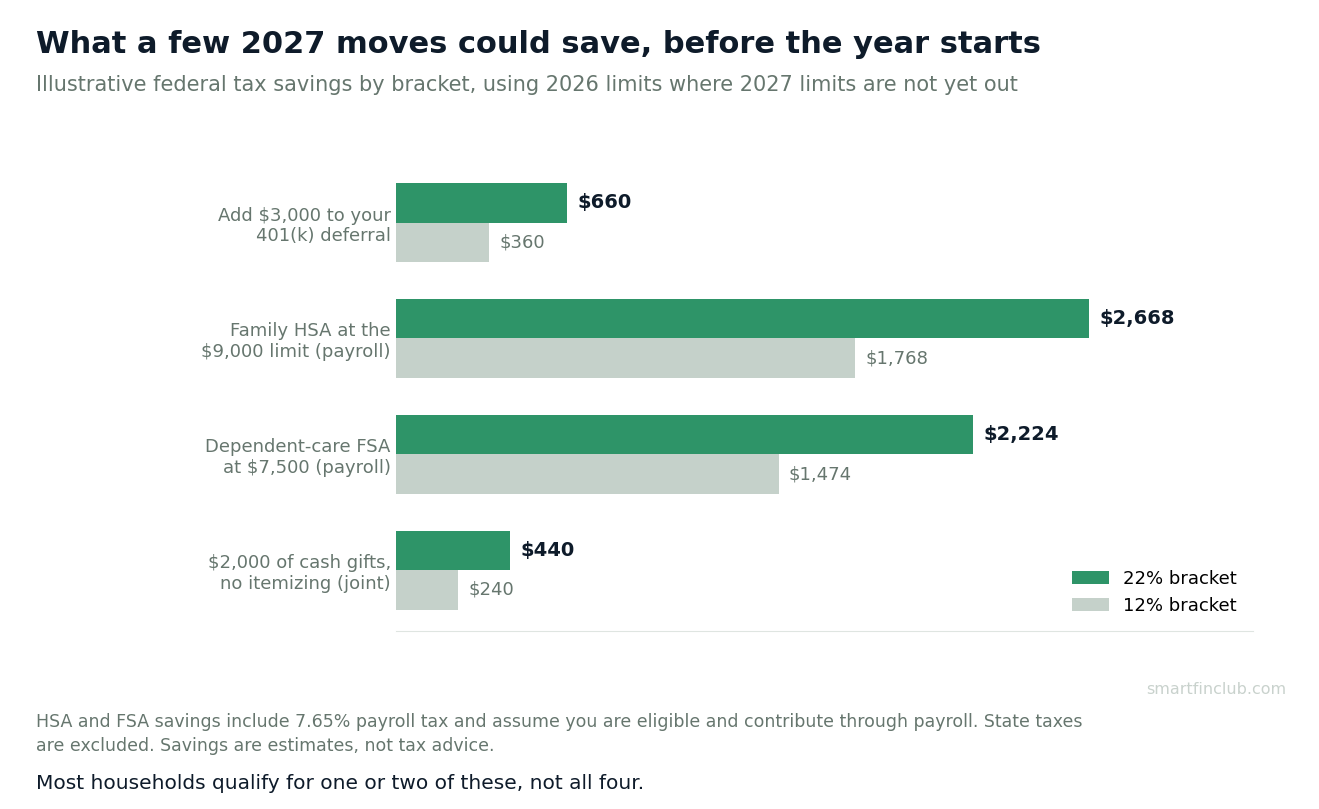
Raise your 401(k) deferral. The 2026 employee limit is $24,500. If you can add $3,000 over the year, that is about $115 per biweekly paycheck before tax. At a 12% federal bracket the tax saved is about $360; at 22% it is about $660. Your take-home pay drops by less than the deferral, because part of it comes back as a smaller tax bill. Our Take-Home Pay calculator shows the actual change in your paycheck.
Here is the trade in plain numbers. A $3,000 deferral at the 22% bracket lowers your take-home pay by about $2,340 for the year, not $3,000, because the tax saving cushions it. At 12% the drop is about $2,640. And the money is still yours, invested in the account, growing for retirement.
Spread across 26 biweekly paychecks, that same deferral trims each check by about $90 at 22% or $102 at 12%, against $115 going into the account. Before you pick an amount, also ask whether your employer matches contributions and how. A match is pay you leave unclaimed if you contribute too little to earn it, so it is often worth capturing first.
Pick the HSA if you have a qualifying plan. For 2027, the IRS limit is $4,500 for self-only coverage and $9,000 for family coverage, plus $1,000 more if you are 55 or older. To contribute you must be covered by a high-deductible health plan, which for 2027 means a deductible of at least $1,750 for self-only or $3,500 for family coverage. Money put in through payroll skips income tax and, usually, the 7.65% payroll tax. At the family limit that is roughly $1,768 to $2,668 a year at the 12% and 22% brackets, and the money can grow and be used for medical costs tax free. A high-deductible plan is not right for everyone, so compare the whole cost, not just the tax break.
Use the dependent-care FSA if you pay for child care. The 2026 limit is $7,500 per household, or $3,750 if married filing separately. Run through payroll, a full $7,500 saves roughly $1,474 to $2,224. Ask your employer what the 2027 limit will be, and remember that FSA money generally must be used within the plan rules or it can be lost. The health FSA limit for 2026 is $3,400.
Before open enrollment closes, work through this short list.
- Find the dates. Missing open enrollment can mean waiting a year unless you have a qualifying life event.
- Check which medical plans are HSA-eligible before you compare prices. A plan that does not qualify cannot take HSA contributions.
- Estimate your child-care costs from this year's bills and any known changes, then choose a dependent-care amount you are confident you will spend.
- Ask how the 401(k) change is entered, as a percentage of pay or a dollar amount per paycheck, and when it starts.
- Save the confirmation page, and check your first 2027 paycheck to see that the elections show up.
Start now: two newer breaks
Cash gifts without itemizing. Beginning with tax year 2026, people who take the standard deduction can deduct up to $1,000 ($2,000 on a joint return) of cash gifts to certain qualified charities, according to the IRS. A $2,000 gift on a joint return saves about $240 at 12% or $440 at 22%. That is a real, if modest, tax reason to plan your giving for the year instead of scattering it.
Keep clean records for the new deductions. Legislation passed in 2025 created deductions for the tax years 2025 through 2028 for tips (up to $25,000), overtime pay (the premium portion, up to $12,500, or $25,000 on a joint return), interest on a new car loan (up to $10,000, for a U.S.-assembled vehicle used personally), and a $6,000 deduction per person aged 65 or older. Most have income phase-outs. The senior deduction alone is worth about $720 at 12% or $1,320 at 22% per eligible person. The action for now is simple: keep your final pay stubs, loan statements and any tip or overtime records where you can find them.
A word about the 0% capital gains bracket
If you own investments in a regular brokerage account, some long-term gains can be taxed at 0% when your taxable income is low. For 2026 the 0% ceiling is $49,450 for a single filer and $98,900 for married filing jointly. Suppose a couple has $89,450 of taxable income. They have about $9,450 of room. Selling shares with that much gain and buying them back resets the cost basis, and it can avoid up to $1,418 of future tax at the 15% rate. This is worth thinking about in a low-income year, such as a career gap or early retirement, and it interacts with other benefits, so check before you do it. The 2027 thresholds have not yet been published.
Mistakes that turn a saving into a cost
- Funding an HSA without a qualifying plan. That can create a tax problem you would have to correct later.
- Electing more FSA money than you will spend. Unused FSA money can be lost under the plan's rules.
- Deferring so much that bills go on a credit card. A tax saving that forces you to borrow is not a saving.
- Forgetting your state. The figures here leave out state taxes, and your state may treat some of these moves differently.
What can wait
- Traditional IRA and Roth IRA contributions. You can generally make them until the tax filing deadline for the year, so there is no need to rush in December. The 2026 IRA limit is $7,500, plus $1,100 if you are 50 or older.
- A Roth conversion. The right amount depends on your full year of income, so decide after you know it. Our article on bracket-fill Roth conversions explains the approach.
- The Saver's Credit. If your income is modest, contributing to a retirement account may earn a credit on top of the deduction. For 2026 the adjusted gross income limits are $80,500 for married filing jointly, $60,375 for head of household and $40,250 for a single filer, according to the IRS.
- Withholding changes. If you got a large refund or a large bill this year, updating your W-4 is a good fall task. It does not require a deadline in December.
| Move | When to act | Limit used here |
|---|---|---|
| 401(k) deferral | Before your first 2027 paycheck | 2026: $24,500 |
| HSA | Open enrollment (fall) | 2027: $4,500 / $9,000 |
| Dependent-care FSA | Open enrollment (fall) | 2026: $7,500 per household |
| Cash gifts, no itemizing | Any time in the tax year | $1,000 / $2,000 joint |
| Harvest 0% gains | Before December 31 | 2026: $49,450 / $98,900 taxable income |
Timing and limits at a glance. 2027 limits for items marked 2026 had not been published as of this writing.
What could all of this add up to?
Add the four payroll-and-gift moves above and, if you qualified for every one, the estimate is roughly $3,842 a year at the 12% bracket and $5,992 at 22%. Almost nobody qualifies for all of them: you need a high-deductible plan for the HSA, a dependent-care expense for the FSA, and the cash to defer to a 401(k). For a typical household, one or two of these is the realistic number, so expect hundreds of dollars, sometimes more than a thousand. That is still meaningful for a few hours of paperwork.
The 30-minute plan. Check your benefits enrollment dates. Look at your latest pay stub and W-4. Run your numbers through the Tax Bracket and Take-Home Pay calculators. Pick one move that fits and set it up before the year ends.
We are not tax preparers, and every household's numbers differ, so it is worth talking to a tax professional before making big changes. If you have a question about how these moves would work for you, write to us at Info@smartfinclub.com.