There is a question worth sitting with for a moment: if your car payment is $585 a month, what does your car cost you a month?
The honest answer, for a typical new vehicle, is closer to $965. AAA publishes an annual study called Your Driving Costs, and its September 2025 edition put the average cost of owning and operating a new vehicle at $11,577 a year over a five-year ownership period at 15,000 miles a year — itself a decrease of $719 from the year before. The payment is well under half of that.
The six lines, and which one people forget
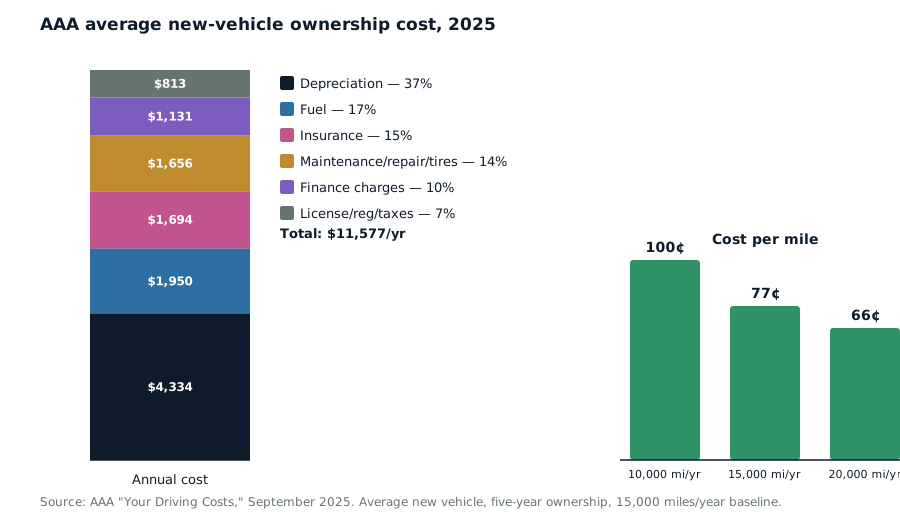
AAA breaks the total into six categories. Here they are, converted to annual figures at 15,000 miles a year:
| Cost | Per year | Share |
|---|---|---|
| Depreciation | $4,334 | 37% |
| Fuel (13.00¢ a mile) | $1,950 | 17% |
| Insurance | $1,694 | 15% |
| Maintenance, repair, tires (11.04¢ a mile) | $1,656 | 14% |
| Finance charges | $1,131 | 10% |
| License, registration, taxes | $813 | 7% |
| Total | $11,577 | 100% |
AAA Your Driving Costs, September 2025. Average new vehicle, five-year ownership, 15,000 miles a year.
Depreciation is the largest single line, at more than a third of the whole. It is also the only one that never sends you a bill, never appears on a statement, and never gets budgeted for. You discover it once, years later, when you find out what the car is worth.
What depreciation actually is. It is not an accounting abstraction and it is not “wear and tear.” It is the difference between what you paid and what someone will give you, spread over the years you held it. You pay it in full, in cash, on the day you sell or trade — and by then it is far too late to do anything about the choice that set it.
Cost per mile is the number that makes decisions
AAA also publishes the total as a rate, and this is where the study earns its keep. The same average vehicle costs:
- $1.00 a mile at 10,000 miles a year
- 77 cents a mile at 15,000 miles a year
- 66 cents a mile at 20,000 miles a year
The rate falls as mileage rises because the big fixed costs — depreciation, insurance, registration, finance charges — get spread over more miles. That is worth stating carefully, because it is easy to misread: driving more does not make the car cheaper to own. It makes each mile cheaper while making the annual total higher. A low-mileage driver in an expensive car is paying a remarkable amount per mile for something that mostly sits still.
Once you have a cost per mile, ordinary decisions become answerable. A 40-mile round-trip commute is about $31 a day at 77 cents, or roughly $7,700 a year, which is a real input into whether a job 20 miles further away is worth the extra salary. A 600-mile weekend trip is $460 in car costs, not the $70 of gas it feels like. The IRS publishes a standard mileage rate for business use each year that exists for much the same reason, and it lands in a broadly similar range.
Where your own number will differ from the average
Averages are a starting point, not an answer, and this one is drawn across nine vehicle categories and 45 models. Four things move your figure most:
The vehicle. Depreciation varies enormously by model, and it is largely set at purchase. A vehicle that holds value can be cheaper to own over five years than a cheaper one that does not — which is the single most useful thing to know before you shop, and the hardest to feel in a showroom.
New versus used. The steepest part of the depreciation curve is the first two or three years, and a first owner absorbs all of it. Buying a three-year-old car does not eliminate depreciation, but it moves you onto a flatter part of the curve. It usually raises the maintenance line at the same time, which is why this is a trade rather than a free win.
Insurance. The single most variable line between two people with the same car. Age, location, record, coverage and deductible all move it, and quotes for identical coverage routinely differ by hundreds of dollars a year.
Finance charges. AAA's $1,131 assumes a particular loan. Yours could be zero, or much more. Long terms are where this line grows: an 84-month loan does not just cost more interest, it also keeps you in negative equity longer, which is the mechanism by which people end up rolling a balance into the next car. Our separate piece on comparing loan offers on total cost rather than payment covers that arithmetic, and the auto loan calculator shows what different terms do.
Estimating depreciation for a car you already own
You do not need a model to get a usable figure. Look up what your exact car, year and mileage is selling for today — private party and trade-in will differ by a meaningful amount, so take both. Subtract that from what you paid. Divide by the years you have owned it. That is your realized depreciation per year, and it is usually the largest number in your motoring budget.
Do it again with a projection: what will it be worth when you expect to replace it? The difference between today's value and that one, divided by the years in between, is what the car will cost you in depreciation going forward. Two things fall out of that immediately. The first is that a car you have already owned for six years is often extremely cheap to keep, because the steep part of the curve is behind you — which is the strongest financial argument for driving a paid-off car until it stops making sense. The second is that “my car is costing me too much in repairs” needs testing against the depreciation on whatever would replace it, and a $1,800 repair bill frequently wins that comparison comfortably.
Two adjustments worth making to the average
If you drive an electric vehicle, the fuel line changes character rather than simply shrinking. Home charging is typically far cheaper per mile than gasoline; commercial fast charging often is not, and the gap is larger than most new owners expect. EV insurance and depreciation have both been volatile enough that the average is a poor guide.
If you keep cars for a decade, the five-year averages understate maintenance and overstate depreciation, and the finance line eventually goes to zero. Long ownership is, on these figures, close to the only reliable way to bring the cost per mile down substantially — and it does it without requiring you to buy anything.
What to do with this
Two practical uses.
First, budget the whole cost, not the payment. If the payment is $585 and the true cost is $965, then $380 a month of real expense is being absorbed somewhere — usually out of savings, in irregular lumps, felt as bad luck. Setting aside the maintenance and depreciation portion deliberately turns a series of unpleasant surprises into a line item.
Second, test the next purchase on five-year cost, not sticker price. That means depreciation plus financing plus insurance plus fuel plus maintenance over the period you will actually keep it. The true cost of car ownership calculator does this with your own figures and returns both a cost per mile and a cost per month. If a lease is also on the table, the lease versus buy calculator puts both options over the same horizon, which is the only way that comparison means anything.
None of this argues for driving less or buying a duller car. Plenty of people look at $11,577 a year and decide it is entirely worth it, which is a perfectly good answer. The problem is only ever the version where nobody looked.