Most financial emergencies are not dramatic. They are a $900 car repair, a medical bill, a week without pay. What turns them into a problem is having no cash to cover them. According to the Federal Reserve’s Economic Well-Being of U.S. Households in 2025 report, published in May 2026, 63% of adults said they would cover a $400 emergency expense using only cash, savings or a credit card paid off at the next statement, and 55% said they had money set aside in a rainy-day fund covering three months of expenses. About 12% said they would be unable to pay a $400 expense by any means.
Step one: find your number
An emergency fund is sized by your essential monthly costs, not your income. Add up what you must pay each month to keep your life running. In our invented example, essentials come to $3,200.
| Essential cost | Monthly |
|---|---|
| Rent or mortgage | $1,400 |
| Utilities | $250 |
| Groceries | $550 |
| Transportation | $350 |
| Insurance | $300 |
| Minimum debt payments | $250 |
| Phone and internet | $100 |
| Total essentials | $3,200 |
An invented example. Include only what you must pay, not what you would like to.
A common guideline is to hold three to six months of essentials. In the example, that is $9,600 to $19,200. That is a rule of thumb, not a law. If your income is steady and you have two earners, you may need less. If you are self-employed or have irregular pay, you may want more. Because the full amount can feel out of reach, start with a smaller step.
To build your own list, look at the last two or three months of bank and card statements instead of guessing. Include bills that arrive only once or twice a year, such as an insurance premium, by dividing each one by 12. A $600 premium billed twice a year is $1,200, which is $100 a month to set aside.
Step two: build it in stages
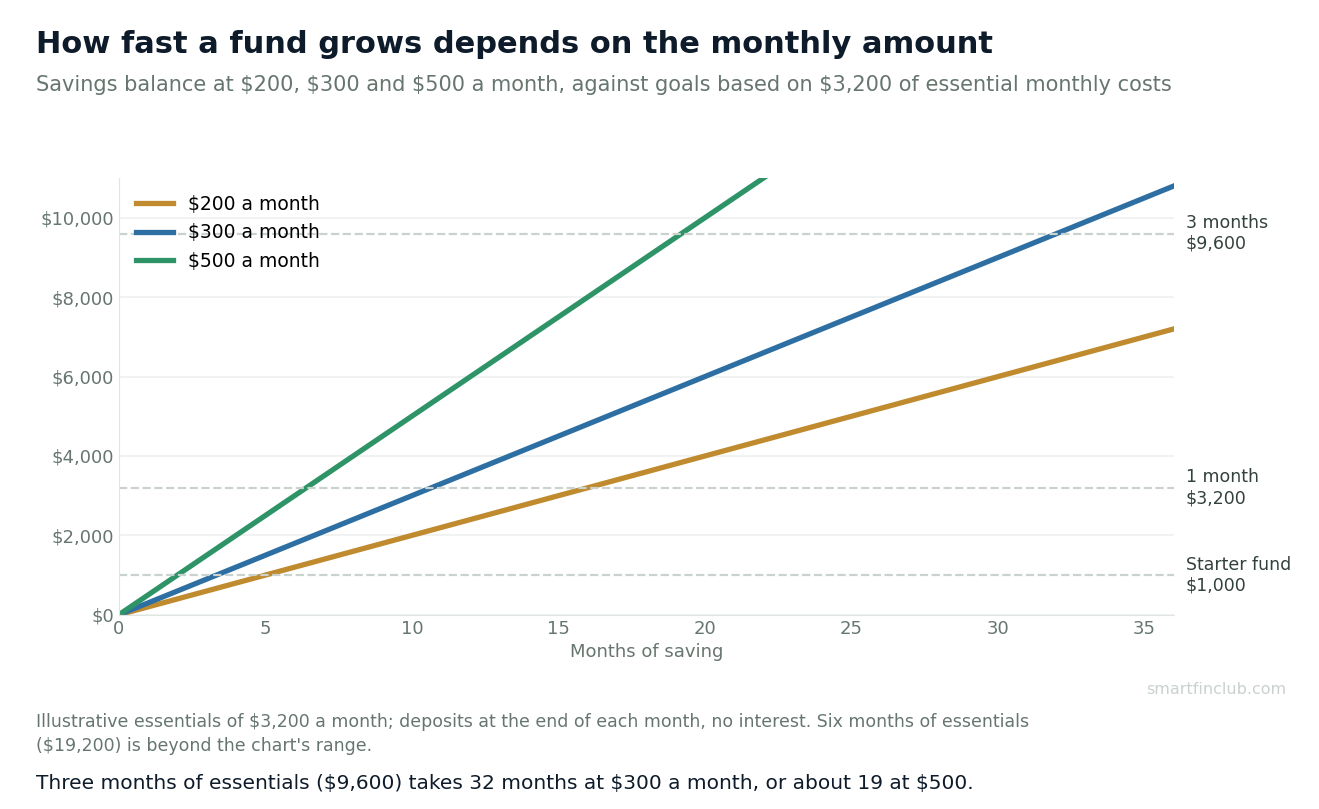
- Stage 1, a starter fund of $1,000. Enough to cover a typical small surprise. At $200 a month, that takes 5 months.
- Stage 2, one month of essentials ($3,200). At $300 a month, about 11 months.
- Stage 3, three months ($9,600). At $300 a month, about 32 months. At $500, about 19.
- Stage 4, up to six months ($19,200). Worth pursuing if your income is uneven or your household depends on one paycheck.
Step three: fund it from what you already have
The Consumer Financial Protection Bureau suggests starting small, automating transfers, and using tax refunds to build a fund. Those are the right tools, and here is how to use your own savings and cash flow.
- Look at savings you already have. If you have cash sitting in checking or an old savings account, move a starter amount into a separate account labeled for emergencies.
- Automate a fixed amount on payday. Even $50 a paycheck works. You will not miss what you never see.
- Redirect windfalls. A tax refund, a bonus or a gift can seed the fund in one move.
- Redirect freed-up money. When a loan ends, keep sending the payment, to the emergency fund first, until it is at the level you want.
- Keep it separate. A dedicated account keeps you from spending it on ordinary things.
What to do with the money once you have it
The rules are simple. Keep it where it is safe and where you can reach it within a day or two, such as a savings account at an insured bank or credit union. Do not put it in investments that can fall in value, and be careful with anything that charges a penalty to withdraw early.
Rates matter a little. The FDIC’s national average for a 12-month certificate of deposit was about 1.71% in August 2026. On $10,000, that earns about $171 a year. An account paying an illustrative 4% would earn $400. That difference is real but modest, and safety and access matter more than the last quarter of a percent. Compare accounts, and read the terms.
Before you open or choose an account for the fund, ask a few plain questions:
- Is it insured? Confirm that the bank or credit union is insured, and check how much of your balance the insurance covers.
- How quickly can I get the money? Find out how long a transfer to your checking account takes, so you know whether it works on a weekend or holiday.
- What are the fees and rules? Ask about monthly fees, minimum balances, limits on withdrawals and penalties for taking money out early.
- Can I automate deposits? A recurring transfer on payday is the easiest way to keep building.
A $900 repair, with a fund and without one
Here is an invented example. Suppose a car repair costs $900 and you need the car to get to work. With a $1,000 starter fund, you pay the bill, and the fund drops to $100. Sending $200 a month back to the account refills it in about 4.5 months, and you have paid no interest.
Without a fund, the bill goes on a credit card. For illustration, assume a rate of 22.15%, the Federal Reserve’s G.19 average for accounts assessed interest, and a payment of $100 a month. That takes about 10 months to clear and costs about $93 in interest, and it happens during the same months when you might have started saving. Your card and rate will differ, but the pattern is the point: the fund pays the bill, while the card rents you the money.
Predictable costs are not emergencies
Many so-called emergencies are bills you could have seen coming: a yearly insurance premium, car registration, holiday spending, routine car or home upkeep. If they drain your emergency fund, you may never reach your target. A simple fix is a second, smaller account for known irregular costs. Add up what you expect to pay in a year, divide by 12, and transfer that amount each month, as in the premium example above. When the bill arrives, it comes out of that account, and your emergency fund stays for surprises.
If your income is uneven
If you are self-employed, paid on commission or work variable hours, the guideline needs an adjustment. Base your essentials on your leanest realistic month, not your best one, and lean toward the upper end of the three-to-six-month range. In good months, add extra to the fund, and in thin months, cover the essentials first and pause the extra. Keeping a record of your lowest income months over the past year shows you how much cushion is realistic.
What counts as an emergency
A real emergency is unexpected, necessary and urgent: a medical bill, a car repair you need to get to work, a job loss, an urgent home repair. A sale, a vacation and a gift are not. If you tend to dip into the fund for wants, write down your own definition of an emergency and keep it with your account information.
Refill it. After you use the fund, rebuild it. Treat the refill as a bill with a due date, and put the same automatic transfer back on payday until you are back at your target.
Mistakes that undo the plan
- Keeping it in checking. Money you can see gets spent. A separate account creates a small, useful barrier.
- Setting the target so high you never start. Six months of essentials is a fine goal and a discouraging first one. Begin with $1,000.
- Counting credit as savings. A credit card limit is not a fund. Using it turns the emergency into debt at a high rate.
- Forgetting to update the number. When your rent, insurance or family size changes, so does the target. Revisit it once a year.
If you also have debt
Debt and savings compete for the same dollars. A common approach is to build a small starter fund first, so an emergency does not go back on a card, and then attack high-rate debt. The Federal Reserve’s G.19 report puts the average rate on card accounts assessed interest at 22.15%. Once the starter is in place, extra money goes to the highest-rate debt. Then you go back to building the full fund. The Debt Snowball and Debt Avalanche calculators show how each payoff order plays out.
Retirement accounts are not an emergency fund. Under current rules, a person may take one penalty-free emergency personal expense distribution of up to $1,000 a year from certain retirement plans, according to the IRS, but early withdrawals generally carry an additional 10% tax. Use that only as a last resort. If you would like help sizing your own fund, write to us at Info@smartfinclub.com.