Somewhere along the way, 20% became the price of admission to homeownership. It is a good number, because it usually avoids mortgage insurance and lowers the payment. But according to the National Association of Realtors’ 2025 buyer profile, the median down payment was 10% for first-time buyers, 23% for repeat buyers and 19% across all buyers. Most first-time buyers are not waiting for 20%. Here is what they are getting instead.
Low-down-payment options exist
- FHA loans. The Consumer Financial Protection Bureau says FHA loans allow a down payment as low as 3.5%, with mortgage insurance required.
- Fannie Mae HomeReady. This conventional program allows 3% down, with mortgage insurance that can be canceled, and homeownership education for first-time buyers.
- VA loans. According to the VA, nearly 90% of VA-backed loans are made without a down payment. They are for eligible veterans and service members.
There are other programs, including state and local down-payment assistance. A HUD-approved housing counselor can point you to the ones in your area. Eligibility depends on income, location and the loan, so ask before assuming.
What each level costs every month
Take a $400,000 home and a 6.95% rate, the Freddie Mac weekly average for a 30-year loan on September 17, 2026. Private mortgage insurance, or PMI, depends on your credit score and down payment, so the prices below are invented to show the pattern, not quotes.
| Down payment | Cash needed | Principal & interest | PMI (invented) | Monthly total |
|---|---|---|---|---|
| 3% | $12,000 | $2,568 | $323 | $2,892 |
| 5% | $20,000 | $2,515 | $253 | $2,769 |
| 10% | $40,000 | $2,383 | $150 | $2,533 |
| 20% | $80,000 | $2,118 | None | $2,118 |
Illustrative $400,000 home, 6.95% for 30 years. PMI is assumed at 1.0%, 0.8% and 0.5% of the loan a year for 3%, 5% and 10% down. Taxes, insurance and closing costs are extra.
The comparison is instructive. Going from 3% down to 20% requires $68,000 more cash and cuts the monthly payment by about $773. That works out to roughly $88 of extra cash for every dollar of monthly savings. In other words, a bigger down payment is not a free lunch. It is a trade: cash today for lower payments tomorrow, and cash tied up in a house cannot be spent on repairs or emergencies.
Another way to see it is the payback on each extra step. Moving from 5% to 10% down takes $20,000 more cash and lowers the monthly total by about $236, so the extra cash takes roughly 7 years to pay itself back. Moving from 10% to 20% takes $40,000 more and lowers the payment by about $415, a payback of roughly 8 years. A payback of seven or eight years is respectable, but only if you stay in the home that long and do not need the cash sooner. It is not a reason to drain your savings.
Who leans toward a bigger down payment, and who does not
- A bigger down payment fits buyers who already have a solid emergency fund, plan to stay for many years, or have a lower credit score that would make mortgage insurance expensive.
- A smaller down payment fits buyers who would otherwise be left with almost no savings, who expect to stay only a few years, or who are in a market where waiting could mean paying much more later.
- Credit matters either way. A stronger credit score can lower both the interest rate and the price of mortgage insurance, so checking your credit report before you apply is worth an afternoon.
A walk-through: the same savings, two ways
Suppose, for illustration, a buyer has saved $20,000 for a down payment, with separate money set aside for closing costs and moving. That is exactly 5% of the $400,000 home, and there are two ways to use it. Put all of it down, and the monthly total is about $2,769, but the buyer moves in with no cash reserve. Or put $12,000 down at 3%, keep $8,000 in the bank, and pay about $2,892 a month. That is $123 more each month, or $1,475 a year, using the invented PMI rates from the table.
Which is better depends on what the reserve would do for you. If a broken furnace or a slow month at work would otherwise land on a credit card, $8,000 in the bank may be worth $1,475 a year. If the buyer already has a full emergency fund, the same extra cost buys very little, and the larger down payment probably wins. The lesson is to price the choice in both directions rather than follow a rule.
The hidden cost of waiting
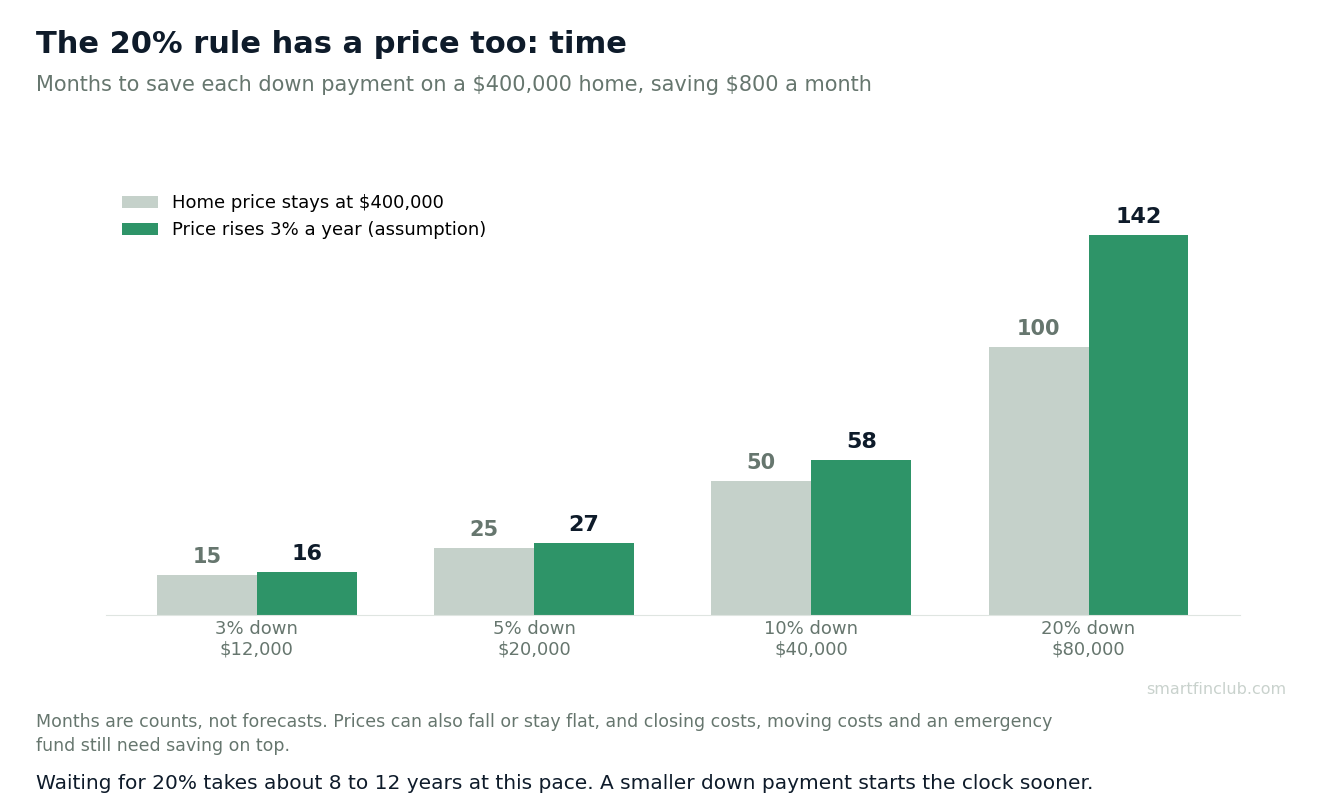
Now the other side. Suppose you can save $800 a month. If prices stay flat, 20% of a $400,000 home takes 100 months, about 8 years. If prices rise 3% a year, an assumption and not a prediction, the target grows too, and it takes 142 months, or about 12 years. A 5% down payment, by comparison, takes 25 to 27 months. During the extra 42 months of waiting, you keep paying rent, and you do not build equity.
Do not forget the other cash. A down payment is only part of what you need. Freddie Mac says to expect closing costs of 2% to 5% of the purchase price. You also want an emergency fund and a repair fund after closing, so the cash you keep in reserve matters as much as the cash you put down.
There is one more cost that does not show up in a payment table: opportunity. Money sitting in a down payment is not earning anything. Money kept in savings is. That is not an argument for always choosing the smaller down payment. It is a reminder that both choices have a cost, and the right one depends on how much cash you would have left.
Where the money can come from
Each common source comes with a question to settle before you count on it.
- Your own savings. Lenders commonly look at bank statements, so large or unexplained deposits can prompt questions.
- Gifts from family. A lender generally wants to see that a gift is truly a gift and not a loan, and may ask for a signed letter and a paper trail. Ask what is required before the money moves.
- Retirement accounts. Taking money out can bring taxes, and sometimes penalties, depending on the account and your age. Talk to a tax professional first.
- Assistance programs. Terms differ by program, and some may come with conditions, such as staying in the home for a set time. Ask before you count on one.
A savings plan you can follow
- Pick a target price range and date, then work backward to a monthly amount. The Down Payment Savings calculator does the math.
- Automate the transfer for the day after payday, so saving happens before spending does.
- Keep the down payment fund separate from your emergency fund, in a safe account you can reach when you need it.
Small changes add up. In the same example, saving $900 a month instead of $800, with prices rising 3% a year, brings the 20% target from 142 months to 120, and the 5% target from 27 months to 24. Those are assumptions, not forecasts, but a bit more each month helps twice: you save faster, and the target has less time to move.
Mistakes that cost buyers money
- Opening new credit before closing. A new car loan or store card changes your debts and can change your approval. Ask your lender what to avoid until you have the keys.
- Comparing only the monthly payment. A lower payment can hide a higher upfront cost. Look at cash needed and monthly cost side by side, as in the table above.
- Counting on assistance before it is approved. Programs can have deadlines, limited funds and eligibility conditions.
How to decide
- Get a real quote. Ask two or three lenders for a Loan Estimate at 3%, 5%, 10% and 20% down and compare the monthly payments and the mortgage insurance line.
- Keep a cushion. If a lower down payment leaves you with real emergency savings, that is often safer than emptying your accounts for a bigger down payment.
- Plan the exit from PMI. On most conventional loans, PMI can be removed once you have built enough equity. Our article on the 80% and 78% rules explains how.
- Think about price, too. A smaller down payment on a less expensive home may beat a larger one on a home that stretches your budget.
- Look at the timeline. If your job, family or plans could change in a few years, a big down payment can be hard to get back when you sell.
None of this means 20% is a bad target. If you can reach it without draining your savings or waiting years, you will pay less each month and avoid PMI entirely. The point is that it is one option among several, and it should not stop you from looking. If you would like to compare your own numbers, write to us at Info@smartfinclub.com, or reach out to a local realtor or lender.