Closing costs are the fees and prepaid items you pay to finalize the loan and transfer the home, over and above the down payment. Freddie Mac says to expect between 2% and 5% of the purchase price. On a $400,000 home, that is $8,000 to $20,000, a wide range. The good news is that you have more control over it than most buyers realize.
What is in the bill
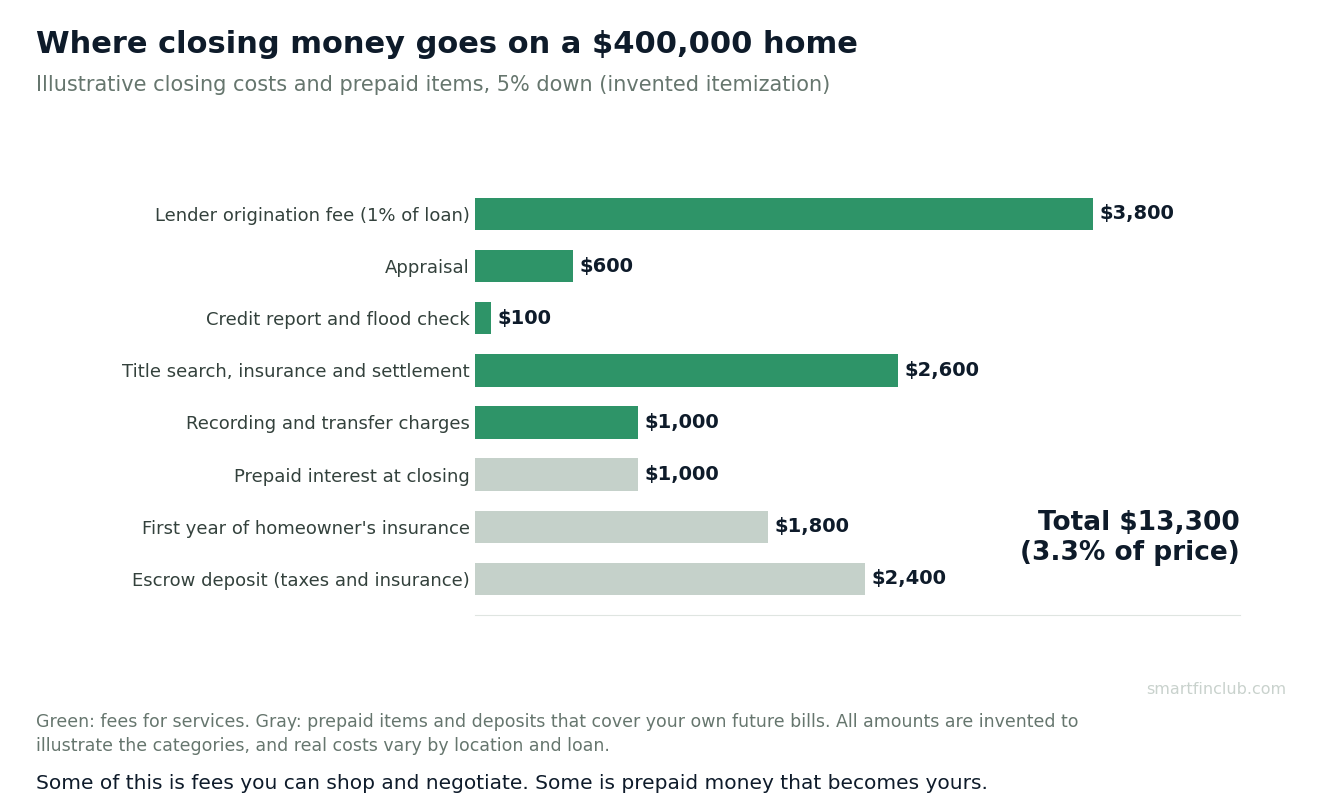
Here is an invented example, to show the categories. On a $400,000 home with 5% down, the itemization comes to about $13,300, or 3.3% of the price. Your actual bill will differ by lender, state and property.
- Lender charges. An origination fee, sometimes described as a percentage of the loan, plus charges for the credit report and flood check.
- Third-party services. The appraisal, title search and title insurance, and settlement or attorney fees. In some states an attorney is customary.
- Government charges. Recording and transfer fees and, in some places, transfer taxes.
- Prepaid items. Interest from closing day to the end of the month, the first year of homeowner's insurance and an initial deposit into the escrow account. The Consumer Financial Protection Bureau describes escrow as an account your lender uses to pay taxes and insurance for you.
The last group is the one buyers overlook. Prepaid items are not fees. They are your own future bills, paid in advance, and you would owe them anyway. But they must be in your bank account on closing day.
Sorting the bill by how much you can influence it
In the invented example, the $13,300 falls into four piles. Prepaid items come to $5,200, or 39%. Lender charges are $3,900, third-party services $3,200 and government charges $1,000. Trimming the prepaid pile mostly moves the cost to later, and government charges are set by local rules, so there is usually little to negotiate. That leaves about $7,100 where comparing quotes and asking questions can matter, so focus there rather than chasing every line.
This is also why one low quote can mislead. A lender showing a lower total may be assuming fewer prepaid items, a lower insurance estimate, or a rate with a credit built in. Compare like with like: the same loan amount, the same rate lock length, and the same assumptions for taxes and insurance.
What you can shop and negotiate
The CFPB says your Loan Estimate lists the settlement services you can shop for, and recommends asking multiple lenders for one so you can compare. The Loan Estimate is a standard three-page form, so comparing them is easier than comparing quotes in your own words. Lender fees and the rate are the obvious places to start. Ask each lender to explain any charge you do not recognize.
The Closing Disclosure is the final version. The CFPB says the lender must give it to you at least three business days before closing. Read it against your Loan Estimate, line by line. If a fee has risen or a new one has appeared, ask why, and ask what you can do about it before the day you sign.
Three ways to lower or cover the bill
- Ask the seller for a credit. A seller can contribute toward your closing costs, up to limits set by your loan program. A $10,000 credit on this example would cover about 75% of the bill.
- Take a lender credit. A lender credit lowers your closing costs in exchange for a higher rate, the opposite of paying points. Suppose a 1% credit ($3,800 here) came with a rate of 7.25% instead of 6.95%. The payment rises by about $77 a month, so after roughly 49 months you have paid back the credit, and every month after that costs you more. That can be a good trade if you may sell or refinance soon and a bad one if you will stay. These figures are invented.
- Or the reverse: pay points. One point, 1% of the loan, is $3,800 on this loan. If it lowered the rate by 0.25%, the payment would fall by about $63 a month and the point would take about 5.0 years to pay for itself. That is also invented, but it shows why the question is always how long you will keep the loan.
Ask for cash to close in one number. Cash to close is your down payment plus your closing costs, minus any earnest money you already paid and any credits. In our example: $20,000 + $13,300 − $4,000 of earnest money = $29,300. Ask your lender for this figure early, and plan to bring a little more than it says.
Put together, the cash you need is the down payment plus closing costs. With 5% down on a $400,000 home, that is $20,000 for the down payment plus $8,000 to $20,000 in closing costs, so $28,000 to $40,000 in total. Many buyers budget for the first number and are startled by the second. Budgeting for both from the start is one of the kindest things you can do for your future self. Our article on down payments compares what each down payment level costs each month.
If you come up short
If your cash-to-close figure is bigger than your savings, do not put closing costs on a credit card and hope. There are steadier moves to weigh, and each has a trade-off.
- Ask about a seller credit before you write the offer. A credit only helps if it is part of the deal, so raise it with your agent and ask your lender what your loan allows.
- Compare a lender credit. It lowers your cash today and raises your rate, as in the example above. Ask for the break-even time in months.
- Ask about assistance programs. Some help with closing costs as well as the down payment, and some do not. Your lender or a housing counselor can tell you which apply where you live.
- Consider a lower price. Closing costs generally rise and fall with the price and the loan, so a smaller purchase shrinks both bills.
- Give yourself more time to save, if the purchase is not urgent, and weigh that against the chance that prices or rates move.
Questions worth asking every lender
- What is your estimate of my total cash to close, and how sure are you of it?
- Which fees on the Loan Estimate are yours, which are third parties', and which of those can I shop for?
- What rate and fees would I see with no points, and what would I see with a lender credit or with points?
- How long is the rate lock, what does it cost to extend it, and what happens if closing slips?
- Will you require an escrow account, and how much will you collect at closing?
From offer to keys: a closing-cost timeline
- Before you make an offer. Get Loan Estimates from two or three lenders for the same loan amount, and compare cash to close, not just the rate.
- After the offer is accepted. Get homeowner's insurance quotes right away. The first year is paid at closing, so the premium changes both your cash to close and your monthly payment.
- When you lock your rate. Write down the lock's expiration date and compare it with your closing date. If closing might slip, ask now what an extension would cost.
- When the Closing Disclosure arrives. The CFPB says you should have it at least three business days before closing. Compare it with your Loan Estimate and ask for a written explanation of any change.
- Before closing day. Confirm the exact amount and how to pay it. If you are asked to wire money, call the title or settlement company at a number you already trust, not one from an email, because scammers are known to imitate them.
Common surprises
- A rate lock that expires before closing, followed by a higher rate or an extension fee.
- A homeowner's insurance quote that comes in higher than you assumed, which changes the prepaid amount and the monthly payment.
- Title or survey problems that add charges late in the process.
- A last-minute change in your loan, your credit or your income that reprices the loan.
Most of these are avoidable if you ask early, get everything in writing and compare your Loan Estimate with your Closing Disclosure. If you have questions about a specific charge, reach out to a local realtor or a loan officer, or write to us at Info@smartfinclub.com.