When you apply for a mortgage, a lender checks whether you fit inside its rules. It looks at your income, your debts, your credit and the home. What it does not check is whether you will have money left for a car repair, a vacation or a retirement contribution. That part is yours.
The ratio lenders use
The Consumer Financial Protection Bureau describes your debt-to-income ratio, or DTI, as your total monthly debt payments divided by your gross monthly income. Gross means before taxes. A lender adds the new housing payment to your other monthly debts, such as a car loan, student loans and minimum credit card payments, and divides by what you earn.
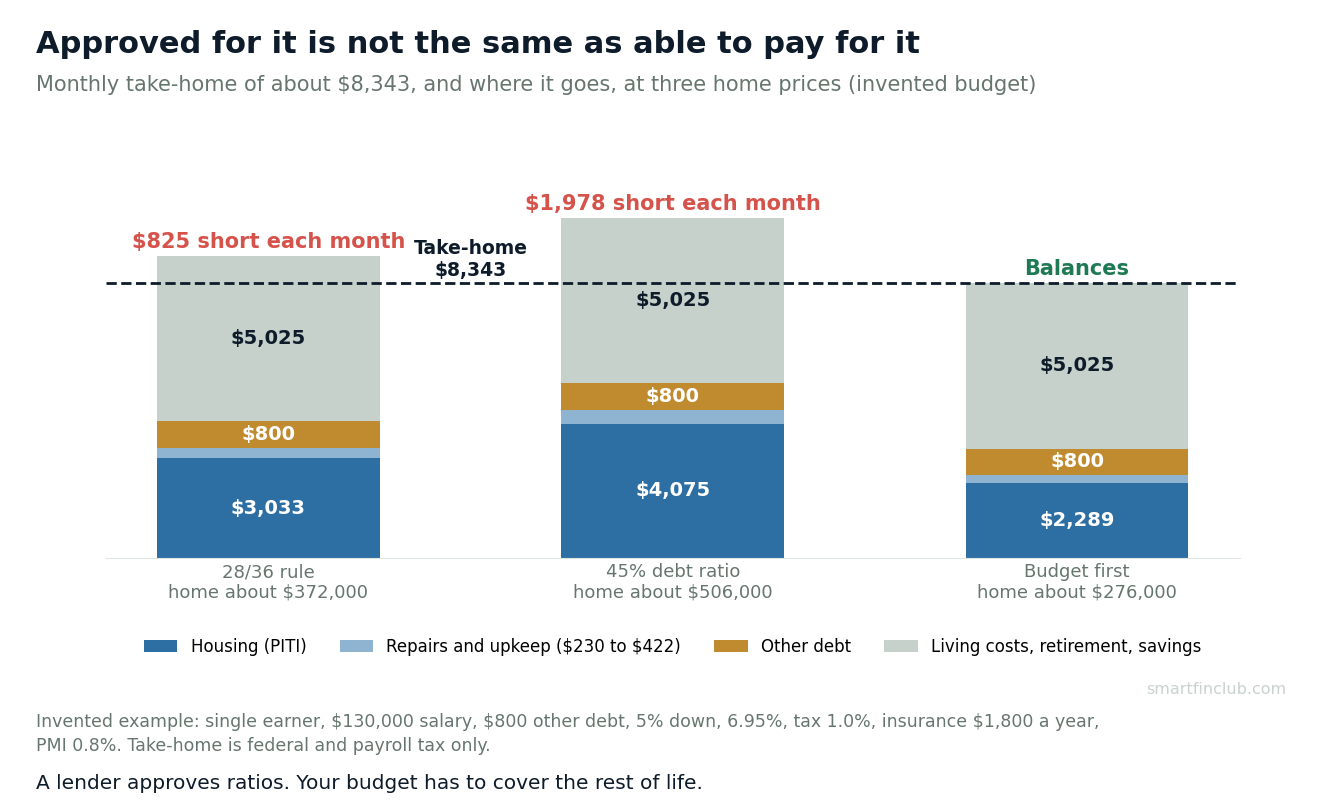
Take a single buyer earning $130,000 a year, or about $10,833 a month before tax, with $800 a month in other debt payments. After federal income tax and payroll tax at 2026 rates, take-home pay is about $8,343 a month. This is an invented example, but the arithmetic works for anyone. Now compare three ways to decide how much to spend on a home.
The rule of thumb. An old guideline says to keep housing under 28% of gross income and total debts under 36%. Here the 28% limit binds first: a housing payment of about $3,033 buys a home near $372,000. A stretched approval. Some lenders will go well past those numbers. At a 45% total ratio the housing payment could be $4,075, and the buyer could be approved for about $506,000. Budget first. Now start from the other end. Suppose this buyer wants to keep saving 12.5% of gross pay for retirement ($1,625 a month), needs $2,900 a month for food, utilities, transportation and insurance, and wants $500 for savings and fun. After that and the $800 of debt, only about $2,518 a month is left for housing and upkeep. That points to a home near $276,000.
| Approach | Home price | Monthly housing | Month-end gap |
|---|---|---|---|
| 28/36 rule of thumb | $372,000 | $3,033 | −$825 |
| 45% total debt ratio | $506,000 | $4,075 | −$1,978 |
| Budget first | $276,000 | $2,289 | $0 |
Gap = take-home minus housing, upkeep at 1% of home value a year, $800 of other debt and $5,025 of planned spending. Illustrative: 5% down, 6.95%, taxes 1.0% of price, insurance $1,800 a year, PMI 0.8%.
A note on rates. The table uses 6.95%, the Freddie Mac average for September 17, 2026. By October 8, 2026 the weekly average had risen to 7.40%. At a higher rate the same monthly payment buys a smaller home, so every price in the table would be lower. Re-run the numbers at today's rate before you rely on them.
Read the table this way. The 28/36 home is about $96,000 more than the budget-first home, and it leaves the buyer about $825 a month short of the life they described. The stretched approval falls short by more than double that. Neither buyer would be turned down by a lender. Both would feel the squeeze every month.
What a monthly gap adds up to
A shortfall of $825 a month can sound small until you multiply it. Over a year it is $9,897, and for the stretched approval it is $23,740. That money has to come from somewhere: savings that slowly drain, retirement contributions that stop, or a credit card balance that grows. The last is the most expensive, because card interest is typically much higher than a mortgage rate. None of the three can go on for 30 years, so a plan that only works on paper is not really a plan.
What the lender's ratio leaves out
Taxes on your pay. DTI uses gross income, but your budget uses what actually arrives in your account.
Retirement savings and health premiums. These come out of your paycheck before the money reaches you, so your real take-home is likely lower than the figure above.
Maintenance. A common rule of thumb, not a sourced figure, is to set aside about 1% of the home's value each year for repairs. On the first home in the table, that is about $310 a month.
Utilities and insurance changes. A bigger house costs more to heat, cool and insure, and insurance and property taxes can rise. If your loan has an escrow account, your payment rises with them.
Your other goals. An emergency fund, a child's college fund and your own retirement all compete for the same dollars.
What to gather before you run the numbers
A budget built from memory tends to come out too generous. Collect the real figures first:
Your last few pay stubs and benefits summary, to see what reaches your account after taxes, retirement contributions and health premiums.
A list of every monthly debt with its balance, minimum payment and payoff date. A loan that ends soon changes your picture.
Three months of bank and card statements, to see what you really spend.
Rough quotes for homeowner's insurance, and the property tax bills or rates for the areas you like.
Any HOA or condo dues for the homes on your list, since they add to your monthly cost.
A better way to set your number
Start with take-home pay, not gross pay. Use the Take-Home Pay calculator or your latest pay stub.
Subtract what you already commit to: debts, retirement savings and insurance premiums.
Decide what you want to keep saving and spending on. Be honest about groceries, child care and the things that make your life yours.
What remains is your true housing budget, including taxes, insurance, maintenance and HOA dues. Work backward to a price using the Home Affordability calculator.
Compare that price to your preapproval. If your number is lower, use your number. The lender will not mind.
A useful test. Put the payment you are considering into your budget for three months before you buy. Transfer the difference between your rent and that payment into savings each month. If it feels tight, or you skip the transfer, the house is probably too expensive for now.
Try to break your number before you buy
Notice that the budget-first buyer's month ends at exactly zero. That is how the example was built, but a plan with no slack is fragile. If you can, aim below the ceiling your budget gives you. Each $100 a month of breathing room you leave lowers the price you are shopping for by about $12,895, so a $200 cushion means a home roughly $25,800 cheaper.
Then run a few what-ifs on paper. What if the property tax bill or the insurance premium rises next year? What if your income drops for a couple of months? What if the furnace or the water heater fails in the same year as a big car repair? What if child care, medical bills or help for a family member adds a cost you did not plan? You do not need exact answers, only a sense of whether the plan would bend or break.
Signs a payment is too high, before you sign
You would need to stop or cut your retirement contributions to make it work.
You would have less than a few months of expenses left in savings after closing.
A single surprise, such as a roof repair or a job change, would put the payment on a credit card.
You are counting on a raise, a bonus or a second income that you do not yet have.
The house you can afford only after stretching needs the same stretch every month for 30 years.
Questions to ask your lender about an approval
What total debt ratio does this approval assume, and is it the most the loan allows or the amount you would recommend?
What property tax and homeowner's insurance estimates did you use, and do they match the areas I am shopping in?
Does the payment you quoted include mortgage insurance, and how long would I pay it?
How would the approval change if I paid off a debt, or if my income or my debts changed before closing?
What would the payment be at a lower price, so I can see the difference in dollars?
If your number is smaller than you hoped
Paying down other debt is the quickest lever. At the rates in our example, every $100 of monthly debt payment you retire raises the housing payment a lender's ratio will allow by $100, which is worth about $12,895 of home price. That does not mean you should buy that much more house. It means that clearing a car loan or a card balance is one of the few moves that helps both your budget and your approval.
A smaller budget is not the end of the plan. It is information, and you have options. You can pay down other debts first, since every dollar of monthly debt payment reduces the housing payment a lender will allow. You can widen the search to a nearby area or a smaller home, save a larger down payment, or wait until your income or savings grow. You can also rent a little longer. Renting is not failure when the alternative is buying a home that keeps you from saving.
Sources: CFPB: What is a debt-to-income ratio? · Freddie Mac: Primary Mortgage Market Survey · IRS Rev. Proc. 2025-32 (2026 tax rates and standard deduction).
Related reading on FinTalks: Closing Costs: The Bill Nobody Warns You About, and How to Shrink It and Rent vs. Buy: The Year You Actually Break Even.
None of this means you should shop for the smallest possible home. Rather, the size of the loan should be set by your life, and the approval letter should be a ceiling, not a target. If you would like to talk through your numbers, write to us at Info@smartfinclub.com, or reach out to a local realtor or a loan officer.