A mortgage front-loads interest. In the early years most of your payment goes to the lender’s charge for lending you the money, and only a little goes to the balance. Every dollar you add above the required payment goes straight to the balance, so it stops earning interest for the lender for the rest of the loan.
Where your first payment goes
On the first payment of this loan, about $2,085 is interest and only about $298 goes to the balance. That is roughly 87% interest. The split changes slowly, so in the early years each extra $100 adds a third to what that month’s payment takes off the balance, from about $298 to $398. That balance is what future interest is charged on, and the reduction compounds for years.
The arithmetic
Take a $360,000 loan at 6.95%, the Freddie Mac weekly average for a 30-year loan on September 17, 2026. The required principal and interest payment is $2,383. If you pay only that, you will pay about $497,884 in interest over 30 years, more than the amount you borrowed.
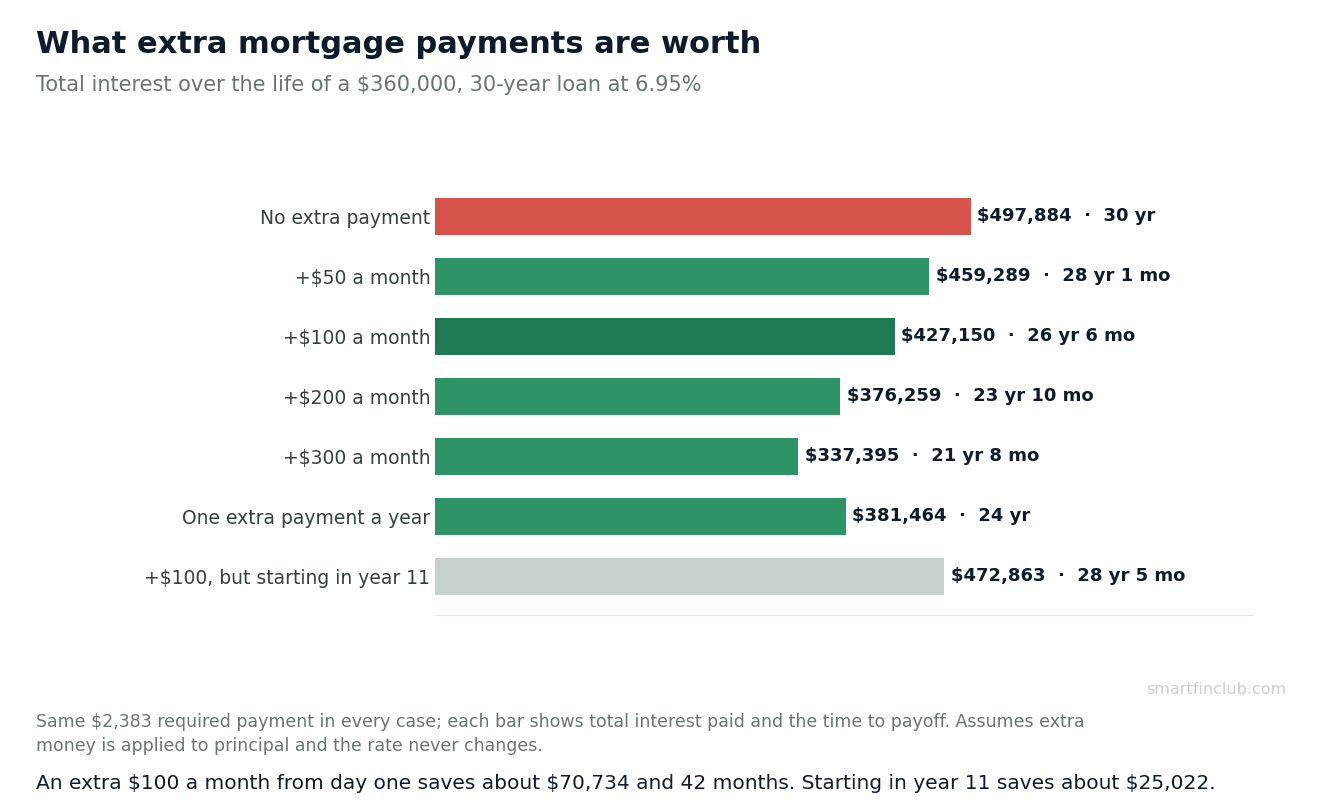
Now add $100 a month from the first payment. The loan is paid off in 26 yr 6 mo, which is 42 months sooner, and total interest falls to $427,150. That is a saving of about $70,734 for $31,800 of extra payments. Put another way, every extra dollar you send saves you about 2.22 dollars in interest.
| Extra payment | Paid off in | Total interest | Interest saved |
|---|---|---|---|
| No extra payment | 30 yr | $497,884 | — |
| +$50 a month | 28 yr 1 mo | $459,289 | $38,596 |
| +$100 a month | 26 yr 6 mo | $427,150 | $70,734 |
| +$200 a month | 23 yr 10 mo | $376,259 | $121,626 |
| +$300 a month | 21 yr 8 mo | $337,395 | $160,489 |
| One extra payment a year | 24 yr | $381,464 | $116,420 |
| +$100, but starting in year 11 | 28 yr 5 mo | $472,863 | $25,022 |
$360,000, 30-year fixed loan at 6.95%. Assumes the extra money is applied to principal each month, or once a year in the annual case.
What each extra dollar buys
Bigger extra payments save more in total, but each dollar does a little less work. In the table, every dollar of the $50 plan saves about $2.29 in interest, while every dollar of the $300 plan saves about $2.06. The larger plan ends the loan sooner, so its last dollars have fewer years to earn anything. The lesson is not to pick the smallest amount. It is to pick an amount you can keep paying, because a plan you abandon in year three saves far less than a small one you keep for thirty.
One caution about these savings. They are interest dollars spread over decades, and a dollar saved in year 25 is worth less to you than a dollar in your pocket this month. The saving is real, but treat it as an approximate size of the benefit, not a check you will receive.
Why starting early matters
Look at the last row. If you wait until year 11 to begin sending the same $100 a month, the payoff is 28 yr 5 mo and the saving is about $25,022, roughly a third of what the same $100 saves from day one. The reason is simple. Interest is computed on the balance you owe, and the balance is largest at the start. An extra dollar in year one has thirty years to work. An extra dollar in year eleven has twenty.
You also build equity faster. After 10 years, the balance on this loan is about $308,560 with the required payment alone and about $291,299 with $100 extra, a difference of $17,261. After 20 years it is $205,696 versus $153,919. Faster equity matters if you might sell, refinance or want to remove mortgage insurance sooner.
What a one-time windfall does
Suppose, for illustration, that you send a one-time $5,000 to principal along with your first payment, and nothing more after that. On this loan, the payoff comes 15 months sooner and total interest falls by about $33,056. If you send the same $5,000 in year 11 instead, the saving is about $14,469. The amount is the same, and the timing is the difference. Before you send a lump sum, read the section below on when to skip extra payments, because high-rate debt and an emergency fund come first.
Ways to do it without feeling it
- Round up. If your payment is $2,383, pay $2,483. It is a habit, not a budget category.
- One extra payment a year. In our example that is about $2,383 once a year, which cuts the loan to 24 years and saves about $116,000. Splitting it into 12 slightly larger payments, or paying every two weeks, has a similar effect. Ask your servicer how it applies biweekly payments and whether it charges a fee.
- Windfalls. A tax refund, a bonus or part of a raise can go to principal without touching your monthly budget.
- Tell the servicer. Ask that extra money be applied to principal. Otherwise it may be treated as an early payment on next month’s bill.
Check that it worked
After your first extra payment, look at the next statement. The balance should have dropped by the scheduled principal, about $298 in this example, plus your extra $100, or about $398 in all, leaving a balance near $359,602. If the drop is smaller, the extra may have been held as a prepayment of next month’s bill instead of applied to principal. Call the servicer, ask them to correct it, and keep a record of the call and the date.
A few questions are worth asking before you start:
- How do I mark an extra payment as principal only, online or by check?
- Do you charge a fee for biweekly payments, and do you apply each half-payment when you receive it or hold it until the full amount arrives?
- Does my loan have a prepayment penalty, and can you show me the clause?
- If I pay mortgage insurance, does an extra payment change when it can end?
When to skip it, at least for now
Extra mortgage payments are not always the best use of a dollar. Prepaying a 6.95% loan is like earning a guaranteed 6.95% on that money, which is good, but other uses may beat it:
- Credit card debt. The Federal Reserve’s G.19 report puts the average rate on card accounts that were assessed interest at 22.15% in the second quarter of 2026. Paying that down first is a far bigger saver.
- Your emergency fund. Money in the house is hard to get back out. If you have less than a few months of expenses saved, build the cushion first. Our article on building an emergency fund shows how.
- An employer 401(k) match. A match is an immediate return that is hard to beat. Our article on the 401(k) match explains why.
- Prepayment penalties. Most home loans do not have them, but check your note. Your servicer can tell you.
Here are three invented households to show how this works in practice. The first has a credit card balance and only one month of expenses saved, so the extra $100 belongs on the card and in savings first. The second has paid off its cards, has a comfortable emergency fund and already gets its full employer match, so an extra payment on the mortgage is a reasonable next step. The third has all of that in place but a low mortgage rate, so it may prefer to spend or invest the money instead. None of these is the right answer for everyone, and each is a choice you can revisit.
Finding the $100
If $100 feels like a stretch, start smaller. Our table shows even $50 a month cuts the loan by 23 months and saves about $38,600 in interest. Look at what is already leaving your account: a subscription you no longer use, a phone plan you could renegotiate, an insurance quote you have not compared in years. Many households also find that a raise or the end of another loan is the easiest moment to redirect money. When a car loan ends, keep sending the payment, to the mortgage instead of to your everyday account.
Check the trade. The right comparison is your mortgage rate against what your money could earn or save elsewhere. A higher rate on the mortgage makes prepaying more attractive. A lower rate makes it less so.
A five-minute plan
- Find your current balance, rate and remaining term on your latest mortgage statement.
- Enter them in the Extra Mortgage Payment calculator and try $50, $100 and $200.
- Choose the amount you can keep up through a bad month, not just a good one.
- Set up an automatic transfer, and confirm in writing how your servicer applies the extra money.
- Check once a year. When your income rises or another debt ends, raise the amount.
None of this requires a big plan. An extra $50 or $100 a month, started early and kept up, is one of the few ways an ordinary household can shave years off a large debt. If you would like help deciding, write to us at Info@smartfinclub.com, or check with your lender or a local financial professional.