Few retirement choices are as permanent as when to claim Social Security. The Social Security Administration adjusts your monthly benefit based on the age you start, and that adjustment generally lasts for life. There is no single right answer, but there is a right way to frame the question.
How the age you claim changes the check
If you were born in 1960 or later, your full retirement age is 67, according to the SSA. Claiming at 62, the earliest age, reduces your benefit by about 30%. Waiting past full retirement age earns delayed retirement credits of 8% a year until age 70, which is 24% more at 70. Those credits stop at 70, so there is no reason to wait beyond it.
Take someone whose full-retirement-age benefit is $2,000 a month. That is close to the average retired-worker benefit, which the SSA put at about $2,071 a month after the 2026 cost-of-living increase of 2.8%. At 62 the check would be about $1,400. At 67 it would be $2,000. At 70 it would be $2,480. The gap between claiming at 62 and at 70 is $1,080 a month, more than 75% higher.
The break-even question
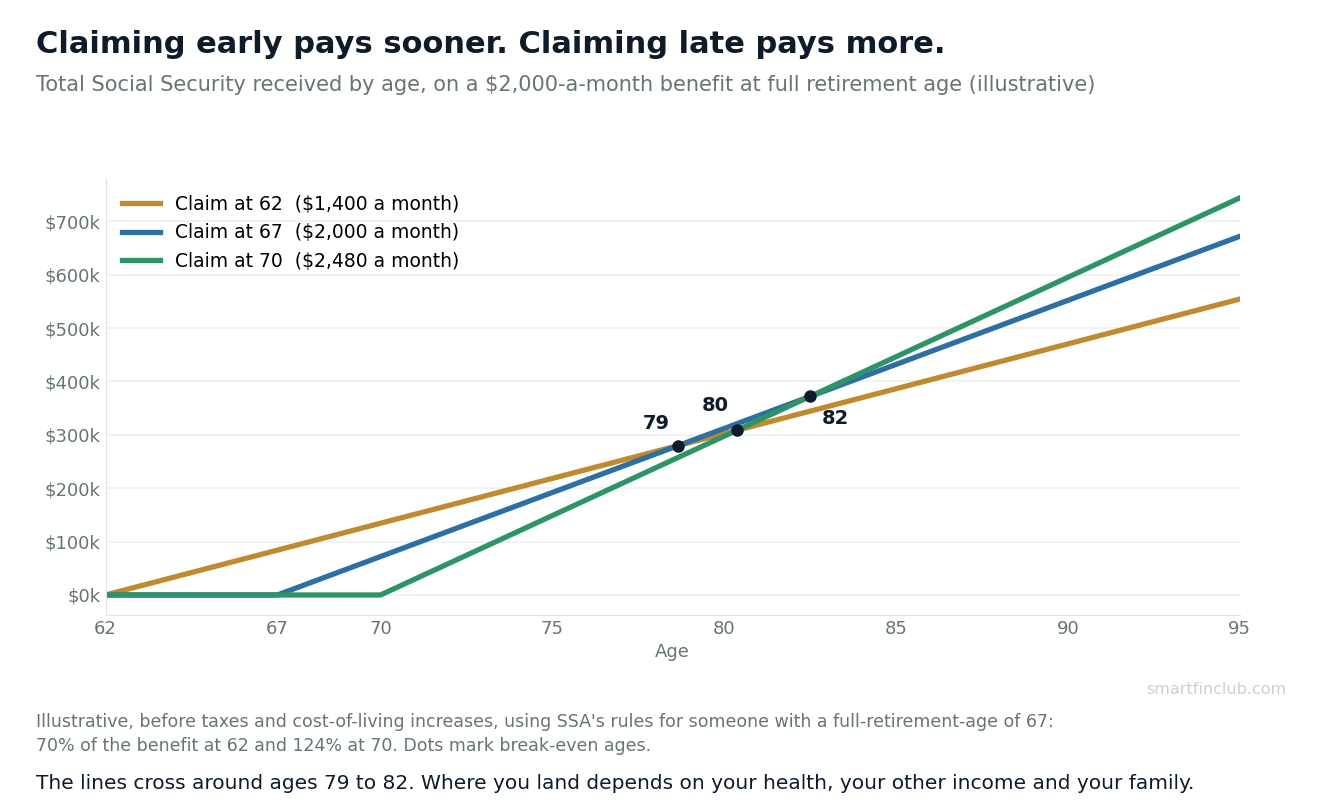
Claiming early gets you more checks. Claiming late gets you bigger ones. The break-even age is when the bigger checks have caught up in total. In our example, and ignoring taxes and cost-of-living adjustments, waiting from 62 to 67 pays off if you live to about 79. Waiting from 67 to 70 pays off at about 82.5. Waiting from 62 all the way to 70 pays off at about 80.
| Claim at | Monthly check | Total by age 85 | Total by age 90 |
|---|---|---|---|
| 62 | $1,400 | $386,400 | $470,400 |
| 67 | $2,000 | $432,000 | $552,000 |
| 70 | $2,480 | $446,400 | $595,200 |
Cumulative benefits before taxes and cost-of-living increases, on a $2,000 full-retirement-age benefit. Illustrative arithmetic, not an SSA calculation.
Here is how to read the table. By 85, the person who claimed at 62 has collected about $386,400, the person who claimed at 67 about $432,000, and the person who claimed at 70 about $446,400. By 90 the totals are $470,400, $552,000 and $595,200. Before the break-even ages the earlier claimer is ahead. After them the order flips, and the gap widens every year.
What the break-even math leaves out
Break-even ages are a useful yardstick, but they treat a dollar received at 63 the same as a dollar received at 85. They are not the same. Money in hand earlier can pay off a debt, cover a health cost or reduce what you must take from savings. The math also ignores taxes and cost-of-living increases. Those increases are applied as a percentage of your benefit, so a larger check generally gets larger dollar increases, which our table leaves out. Use the break-even age as a range to plan around, not a forecast of how long you will live. Nobody knows that, and a plan that pays off only if you die on schedule is not much of a plan.
How long will you live?
This is the uncomfortable part. The SSA's period life table for 2023 shows that a 65-year-old man can expect to live about 18 more years and a 65-year-old woman about 21. A man of 62 has about 20 more years, and a woman of 62 about 23. Those are averages, and about half of people live longer. Your own health and family history matter more than any table.
Longevity is also why the choice is really about risk. Claiming early gives up income in the years you might live long. Claiming late risks collecting less if you do not. For a married couple, the higher earner's choice can also affect the survivor's benefit, so it is worth asking the SSA how it would work in your case.
Other things that change the answer
Working while you claim early. If you claim before full retirement age and keep working, your benefits may be reduced when your earnings exceed a limit. In 2026 that limit is $24,480, and it is $65,160 in the year you reach full retirement age, according to the SSA.
Other income. If you have savings or a pension to live on, waiting may be easier. If not, claiming early may be a necessity, not a choice.
Taxes. Social Security benefits may be taxable depending on your other income. Delaying can also shift when you draw from your other accounts.
Health. A serious health condition may argue for claiming sooner. Good health and a family history of long life may argue for waiting.
Your earnings record. Benefits are based on your highest 35 years of earnings, so check your record at ssa.gov to confirm it is correct.
Three situations, three different answers
You are still working at 62 and healthy. Claiming early while you earn above the limit can mean your checks are reduced, and you would lock in a smaller benefit for life. Waiting often makes sense here, if you have earnings to live on.
You have lost your job or have health problems. Claiming early can be the right call. A smaller check now may matter more than a larger one later, and there is no shame in that.
You are married and one of you earned far more. The higher earner's claiming age can shape what the surviving spouse receives. It is worth running the numbers for both of you before either claims.
Some people also use what is sometimes called a bridge: they live on savings, part-time work or a pension for a few years so that they can delay claiming and lock in a larger check. That trades money in your accounts today for more guaranteed income later. Whether it is worthwhile depends on your savings, your expected retirement length and your comfort with spending down other accounts first.
Here is what a bridge looks like in numbers, using our $2,000 example. Suppose you are 62 and could claim $1,400 a month, but you would rather wait until 67. Covering those five years yourself means finding about $84,000 from savings, wages or a pension, which is the $1,400 a month you are not collecting for 60 months. In exchange, your check is $600 a month higher, or $7,200 a year, for as long as you receive it. Dividing the two shows it takes about 11.7 years to earn back the bridge, which is why the break-even age lands near 79, before taxes and cost-of-living increases.
Start from your monthly gap
A practical way to compare claiming ages is to start with what you need, not with the check. Suppose a household's essential costs are $3,000 a month, and one Social Security benefit is the only guaranteed income. Using the $2,000 example, the gap that savings or work must fill is $1,600 a month if you claim at 62, $1,000 at 67 and $520 at 70. Over a year, that is $19,200, $12,000 and $6,240. This example is invented and ignores taxes, but the exercise is real: the smaller your gap, the less pressure your savings are under in a long retirement.
Common mistakes to avoid
Deciding from a friend's story. What was right for a friend's health, marriage and savings may be wrong for yours.
Looking only at the monthly check. A bigger check at 70 does not help if you drained your savings to get there and then face a large bill.
Overlooking the earnings limit. If you plan to keep working after claiming before full retirement age, find out how much your check could be reduced before you file.
Never checking your record. A missing year of earnings can lower your estimate, so catch it before you claim.
Treating the choice as reversible. The rules for changing your mind are strict, so plan as if your decision is final.
A practical step. Create or log in to your my Social Security account at ssa.gov. It shows your earnings record and your estimated benefits at different ages, using your own numbers instead of an average.
Before you file, do these four things
Check your earnings record in your my Social Security account and correct any missing years.
Look at your estimated benefit at 62, at full retirement age and at 70, using your own record.
Add up the other income you will have, from savings, a pension or work, and decide how many years you could bridge.
If you are married, look at both spouses' benefits together, including what the survivor would receive.
Sources: SSA: Retirement age and benefit reduction · SSA: Delayed retirement credits · SSA: Receiving benefits while working · SSA: Latest cost-of-living adjustment · SSA: Actuarial life table.
Related reading on FinTalks: The Cost of Waiting: What Starting Ten Years Late Really Costs and The 401(k) Match Is Free Money — If You Clear Two Hurdles First.
None of this is a recommendation for you. It is the framework we would want someone to use: know your check at each age, know the break-even ages, and be honest about your health, your savings and your family. If you would like help thinking it through, write to us at Info@smartfinclub.com, or speak with a qualified financial professional or the SSA.