People often think of saving for retirement as a math problem about how much to put in. It is at least as much a problem about when. The reason has a name, compounding, which just means that your earnings start earning too.
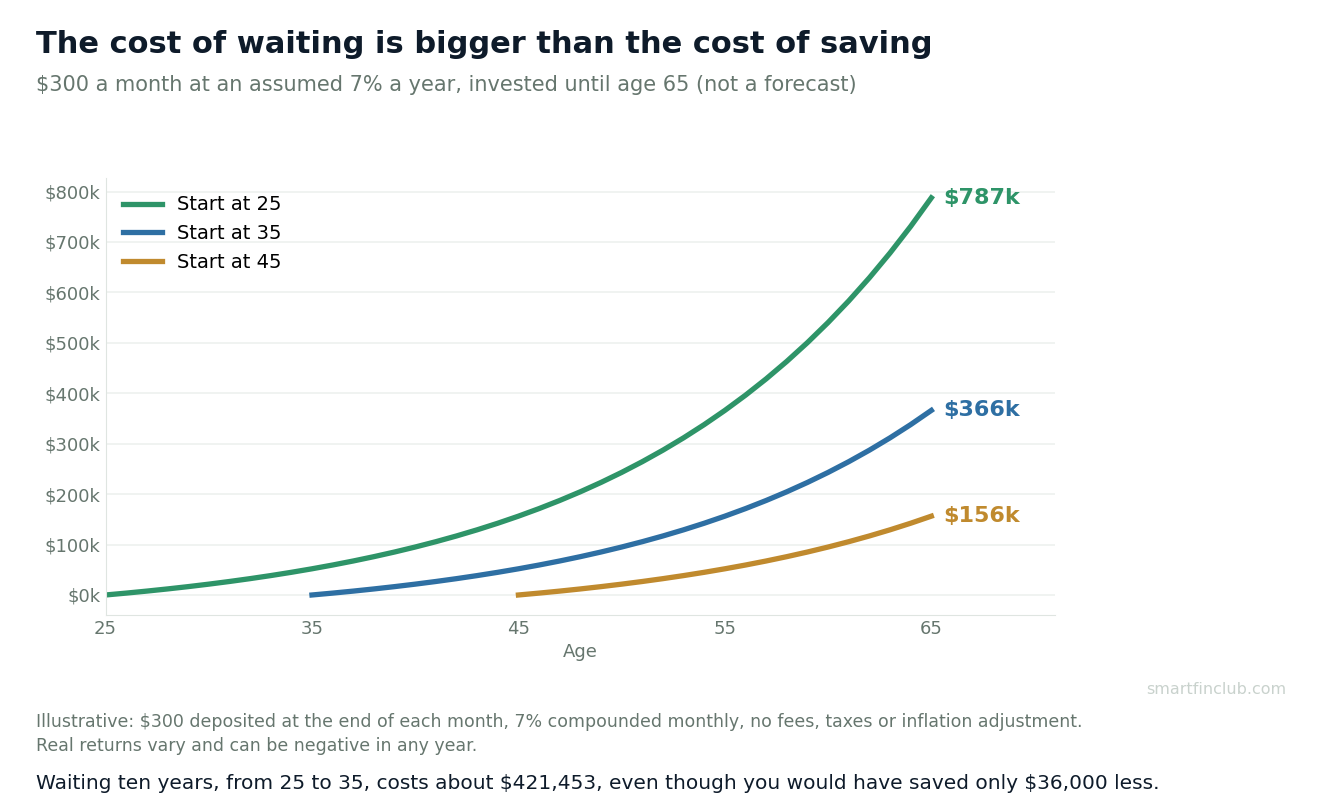
Same $300, three start dates
Suppose you invest $300 a month until age 65 and earn an average of 7% a year. That rate is an assumption, not a promise, and real returns vary from year to year. Start at 25 and you would have about $787,444. Start at 35 and you would have about $365,991. Start at 45 and you would have about $156,278.
| Start age | You deposit | At 5% a year | At 7% a year | At 9% a year |
|---|---|---|---|---|
| 25 | $144,000 | $457,806 | $787,444 | $1,404,396 |
| 35 | $108,000 | $249,678 | $365,991 | $549,223 |
| 45 | $72,000 | $123,310 | $156,278 | $200,366 |
$300 a month until age 65. Rates are illustrations, not forecasts. Taxes, fees and inflation are not included.
Look at what waiting from 25 to 35 does. You would deposit $36,000 less, and you would finish with about $421,453 less. The extra ten years of deposits are only part of the story. The larger part is what those early deposits would have earned for another ten years.
Notice where the money comes from. Of the $787,444 at 65 for the person who started at 25, only $144,000, or 18%, is money they deposited. The other $643,444 is growth. For the person who started at 35, deposits are 30% of the total. For the 45-year-old they are 46%. The longer the money has, the more of the work it does.
What one more year of waiting costs
It helps to shrink the question to a single year. On the same assumptions, a 25-year-old who puts off starting until 26 ends up with about $56,554 less at 65. For someone who would have started at 35, one year of delay costs about $28,141. At 45, it is about $14,003. The dollar cost is largest for the earliest start because the skipped deposits would have had the longest time to grow, but a year of waiting is a year you cannot get back at any age.
A head start beats a bigger total
Here is an invented pair to make the point. Suppose Ana saves $300 a month from 25 to 35, deposits $36,000 in all, and then stops, leaving the money invested. Ben waits until 35 and saves $300 a month all the way to 65, depositing $108,000. With the same assumed 7% a year, Ana would have about $421,453 at 65, and Ben about $365,991. Ana deposits a third as much and still comes out ahead.
That is not advice to stop saving. If Ana kept going, she would reach the $787,444 from the first example. It is a picture of why the earliest dollars are worth so much, and why a small start now is worth more than a large plan later.
A quick way to see it: the Rule of 72
Divide 72 by an annual return to estimate how many years it takes money to double. At 7%, that is about 10.3 years. A dollar invested at 25 doubles roughly four times before 65. A dollar invested at 45 doubles about twice. That is the reason the early dollars matter so much. The Rule of 72 calculator does the division for any rate.
What about inflation?
A fair objection is that $787,000 in 40 years will not buy what it does today. If prices rise 3% a year, an assumption, $787,444 in 40 years has the buying power of about $241,396 in today's dollars. That is a reminder to treat these numbers as illustrations of the pattern, not as a retirement plan. The pattern holds either way: the earlier you start, the more of the work is done by time.
Compounding also works against you. The Federal Reserve’s G.19 report puts the average credit card rate for accounts assessed interest at 22.15%. At that rate, the Rule of 72 says a balance doubles in about 3.3 years if nothing is paid. The same force that builds a retirement account can quietly grow a debt, which is why paying off high-rate balances belongs in the same plan. Our guide to snowball vs. avalanche compares two ways to do it.
If you are already behind
Starting late is not hopeless, but it costs more each month. To match the 35-year-old starter's result, a 45-year-old would need to invest about $703 a month instead of $300. To match the person who started at 25, someone starting at 35 would need about $645 a month, an extra $345, and would deposit $232,366 in total rather than $144,000.
The gap widens with a longer delay. To match the person who started at 25, someone starting at 45 would need about $1,512 a month, roughly 5 times the original $300. For many households that is not realistic, which is why the goal for a late starter is usually to do as well as possible, not to match someone who had more years.
Start small, then step up
If $300 is out of reach today, the choice is not between $300 and nothing. Suppose you are 35 and begin with $150 a month, then add $25 each year until you reach $300, and hold it there to 65. On the same 7% assumption, that path ends near $321,920. If you instead wait six years until $300 feels comfortable, and start at 41, you end near $223,171. The smaller start wins because it puts money to work while you wait for a bigger paycheck. Tie each step-up to something you will notice, such as a raise, a birthday or the first of the year.
There is another way to catch up besides a bigger monthly amount: time. Working a few years longer, or starting withdrawals a few years later, gives the account more years to grow and fewer years to fund. Neither is a plan on its own, but both help, and you can combine them with a higher savings rate.
Where to put the $300
The example does not say which account holds the money. Many people start with a workplace plan, especially one with a match. Others use an individual retirement account, or IRA, whose 2026 contribution limit is $7,500, plus $1,100 more if you are 50 or older, according to the IRS. $300 a month is $3,600 a year, well inside both limits. The right account depends on your tax situation and what your employer offers, so it is worth a quick look at the options before you choose.
Questions to ask before you pick an account
Whichever account you consider, a few plain questions are worth answering before the first deposit. Your plan administrator or the account provider should be able to answer each of them.
- Is there a match, and what do I have to do to get it? Some plans require you to enroll or to wait before the match starts.
- What does it cost each year? Fees on the account and inside the investments come out of your returns every year, so a small difference adds up over decades.
- How is the money invested, and can I change it? Make sure the mix suits how many years you have before you need the money.
- What happens if I need the money early? Some accounts charge taxes or penalties for early withdrawals, and knowing that in advance can keep you from cashing out in a panic.
- Can the deposit rise automatically? A yearly step-up built into the account is easier to keep than a promise to yourself.
What can go wrong
The numbers above are smooth. Real markets are not. Returns can be negative for a year or several years, and an average of 7% hides a wide spread. The biggest risks for ordinary savers are not a single bad year, but stopping contributions when markets fall, paying high fees, and cashing out early. A steady habit, low costs and a time horizon measured in decades are how most people reduce those risks.
Do not let the math discourage you. These figures are not a reason for regret. They are a reason to start now, at any amount, and to raise it as your income grows. A small start today beats a perfect plan next year.
How to start when money is tight
- Start with any amount you will not notice. Even $50 a month teaches the habit.
- If your employer matches contributions, contribute at least enough to get the match. Our article on the 401(k) match explains why.
- Automate the deposit for payday, so it never passes through your checking balance.
- Raise it every time you get a raise, and each time another debt ends.
- Keep an emergency fund, so a surprise expense does not force you to withdraw the money.
Investing involves risk, and returns are not guaranteed. The numbers here show what could happen under stated assumptions, not what will. If you would like help thinking about your own plan, write to us at Info@smartfinclub.com, or speak to a licensed financial professional.