Buyers often do not negotiate for understandable reasons. They fear losing the house. They assume a listed price is a fair price. They are embarrassed to ask. And after weeks of searching, many just want it to be over. The cost of that silence is not small, and it is not the same everywhere.
Why so many buyers stay quiet
The reasons are familiar. A listing price feels like a fact rather than an opening position. Buyers worry that one low offer will send the house to someone else. Asking feels awkward with a stranger, on a purchase that already feels enormous. And many simply do not know that credits, repairs and closing dates are on the table at all. None of these is irrational. But the price on the listing is the seller's opening number, and a purchase contract is a negotiation from the first page.
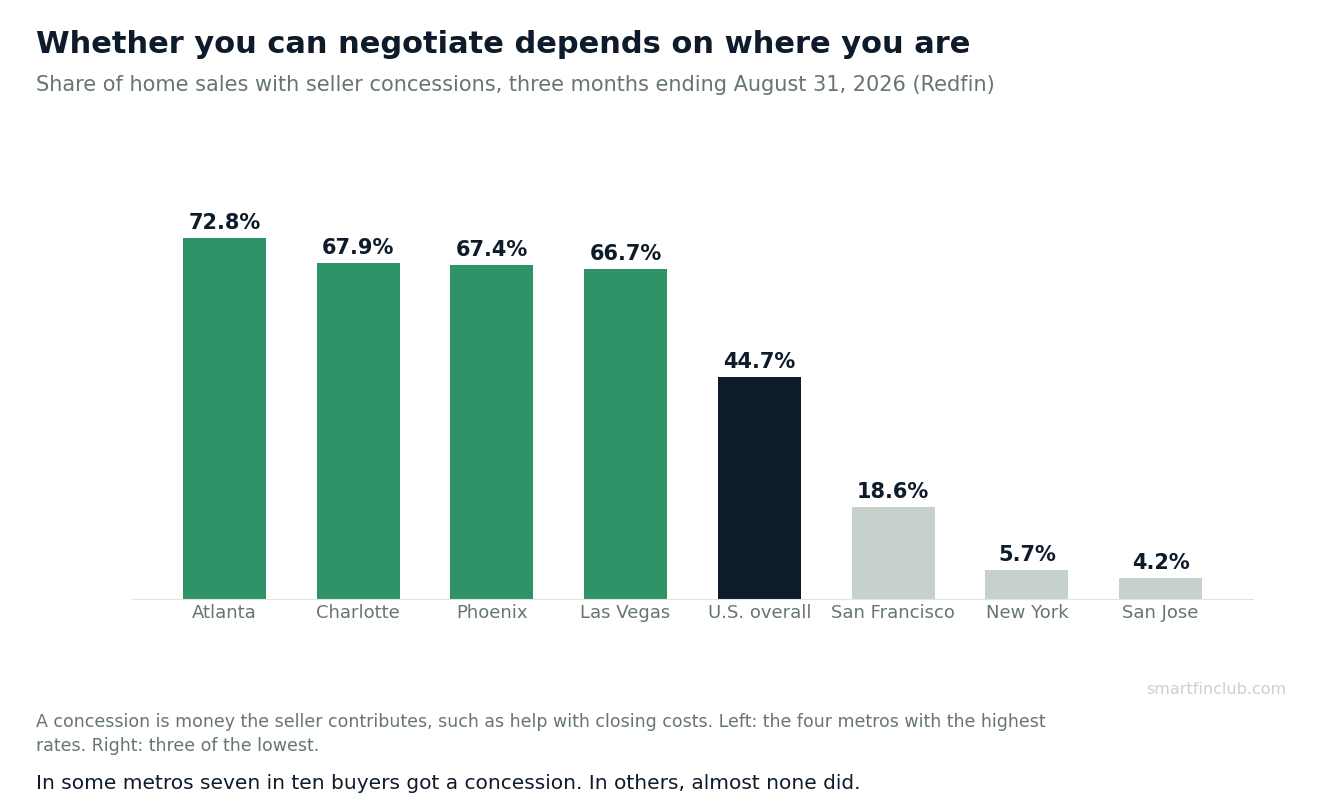
Two numbers frame the picture. In the four weeks ending August 16, 2026, Redfin reported an average sale-to-list price ratio of 98.9%, meaning the typical home sold about 1.1% under its asking price. On a $400,000 listing, that is roughly $4,400. Separately, Redfin found that 44.7% of U.S. home sales in the three months ending August 31 included seller concessions, the highest August share since at least 2020, and that 15.8% of homes had both a concession and a price cut.
Redfin called August the strongest buyer's market in its records, which go back to 2013. The National Association of Realtors reported a 4.6-month supply of existing homes in July, with a median of 29 days on market. The two sources measure supply differently, and Redfin's own figure for the four weeks ending August 16 was 3.8 months, so treat these as directional, not as a verdict on your street.
That last part is the whole point of the chart above. Concessions ran from 72.8% of sales in Atlanta to 4.2% in San Jose. A national average tells you very little about the house you are looking at.
What you can ask for
A lower price. The most direct ask. It lowers your loan, your monthly payment and every dollar of interest.
A credit toward closing costs. Freddie Mac notes you can negotiate with the seller to cover certain fees. For a conventional loan on a primary residence, Fannie Mae caps what a seller can contribute at 3% of the price with a down payment under 10%, 6% with 10% to 25% down, and 9% with 25% or more down.
Repairs or a repair credit. After the inspection, you can ask the seller to fix items or to credit you the cost.
Timing and terms. The closing date, possession date or the seller leaving appliances can be worth real money to the right seller.
Help with the rate. Some sellers will pay for discount points, a point being 1% of the loan amount, or for a temporary rate buydown. Ask your lender how a seller-paid item would be handled.
What a lower price is worth
Suppose you buy a $400,000 home with 10% down at 6.95%, the Freddie Mac weekly average on September 17, 2026. Your principal and interest payment is $2,383. Negotiate $10,000 off, keep the same 10% down, and the payment falls to $2,323, a saving of $60 a month. Over 30 years the interest you pay drops by about $12,447. A $10,000 seller credit toward closing costs would give you $10,000 of cash relief on day one, but no lower monthly payment. Which is better depends on whether your constraint is cash today or payment tomorrow.
A note on rates. The 6.95% above is the Freddie Mac average for September 17, 2026. By October 8, 2026 the weekly average had risen to 7.40%. At 7.40%, the same $360,000 loan costs about $2,493 a month, and a $10,000 price cut would save about $62 a month instead of $60. The principle is unchanged, but run your own numbers at today's rate.
Now compare the alternatives on a single $400,000 purchase. A $10,000 price cut lowers your payment and your interest, as above. A $10,000 closing-cost credit leaves the payment untouched but keeps $10,000 in your account, which matters if cash is tight. A seller-paid rate buydown could lower the payment for a limited time. A repair credit of $3,000 after the inspection is the same as $3,000 you do not spend on the roof, provided the lender allows it. Ask your lender which of these your loan program permits before you decide what to request.
Do this before you make the offer. Ask the agent or use public records to see what similar homes nearby actually sold for, how long each was listed and whether the price was cut. Negotiating with facts is very different from negotiating with a feeling.
Decide your limit before you walk in
Negotiation goes better when you know your own numbers first. Using the example above, each $10,000 of price moves your payment by about $60 a month, so paying $30,000 more than you planned would add about $179 a month in principal and interest alone. Decide your maximum price, and the terms you would trade for it, before you see the house, and write both down.
How to ask without souring the deal
Get preapproved first, so your offer is credible and you know what you can afford.
Make the ask specific and tied to evidence: a comparable sale, an inspection finding, the number of days the home has been listed.
Ask for one or two things, not ten. A clear request is easier to say yes to.
Be willing to trade. If you want a lower price, offer a faster closing or fewer contingencies. Every contingency you waive removes a protection, so think first.
Stay polite and stay ready to walk away. Your best leverage is that you are willing to.
Here is what a good ask can sound like. On price: “We like the house and would like to offer [amount]. [Number] similar homes nearby sold for less, and this one has been listed for [number] days.” On a credit: “The inspection found that the roof needs replacing. Here are two written estimates, and we would like a credit of [amount] at closing.” Each ask has a reason and a number.
When you probably should not push
Negotiating is not free in every market. In a fast market with several offers, a low offer can end the conversation. Signs you should be careful: the home is new to the market or priced below similar homes, showings are crowded, the listing agent says offers are due by a deadline, or homes in your area are selling at or above asking price. Months of supply is a useful rule of thumb here. Analysts commonly treat roughly five to six months as balanced, with fewer months favoring sellers and more favoring buyers. The exact line varies by source and by local market.
Even then, you may be able to compete on terms other than price: a larger earnest money deposit, a flexible closing date, a shorter contingency period. In a buyer's market, the reverse holds. Homes that have been listed a long time, that have had price cuts, or that sit in a market with many sellers are where a request for a concession is most likely to work.
The inspection is your second chance to negotiate
Many buyers think the negotiation ends when the seller accepts. In practice the inspection report opens a second round. If it finds a serious problem, such as a failing roof, an old furnace or signs of water damage, you can ask the seller to repair it, credit you the cost or lower the price. Get written estimates for anything you ask about, so your request is a number and not an opinion. Keep the list to the items that are expensive or unsafe, and let the cosmetic ones go.
Mistakes that cost buyers leverage
Telling anyone your maximum. Your ceiling is the one number the other side would most like to know.
Agreeing on the phone and not on paper. Any credit, repair or date you settle on belongs in the written contract or an addendum. A verbal promise is easy to forget and hard to prove.
Ignoring the appraisal. If the lender's appraisal comes in below your agreed price, another conversation begins, and what happens next depends on your contract and your loan. Know your options before you offer.
A no is information, too. The seller may accept a smaller version of your request, or a different one, such as a closing date instead of a credit. If they will not move at all, go back to your limit and decide from there.
Sources: Redfin: housing market reports · National Association of Realtors: existing-home sales data · Freddie Mac: Primary Mortgage Market Survey · Fannie Mae Selling Guide B3-4.1-02, Interested Party Contributions.
Related reading on FinTalks: Closing Costs: The Bill Nobody Warns You About, and How to Shrink It and You Do Not Need 20% Down. Here Is What Each Down Payment Really Costs..
We are not going to tell you what to offer. That depends on the house, the seller and the week. But the arithmetic above is why asking is worth the discomfort, and why you should do it with the market's actual numbers in your hand. If you would like a local view, reach out to a local realtor, or write to us at Info@smartfinclub.com.