When you owe money on several accounts, one question decides how fast you get out: where does the next extra dollar go? Two answers dominate the advice. Both work. They optimize for different things.
The two methods in a sentence each
- Snowball: pay the minimum on everything, then put every spare dollar on the smallest balance. When it is gone, roll its payment onto the next smallest.
- Avalanche: pay the minimum on everything, then put every spare dollar on the debt with the highest interest rate. When it is gone, roll its payment to the next highest rate.
The same three debts, two plans
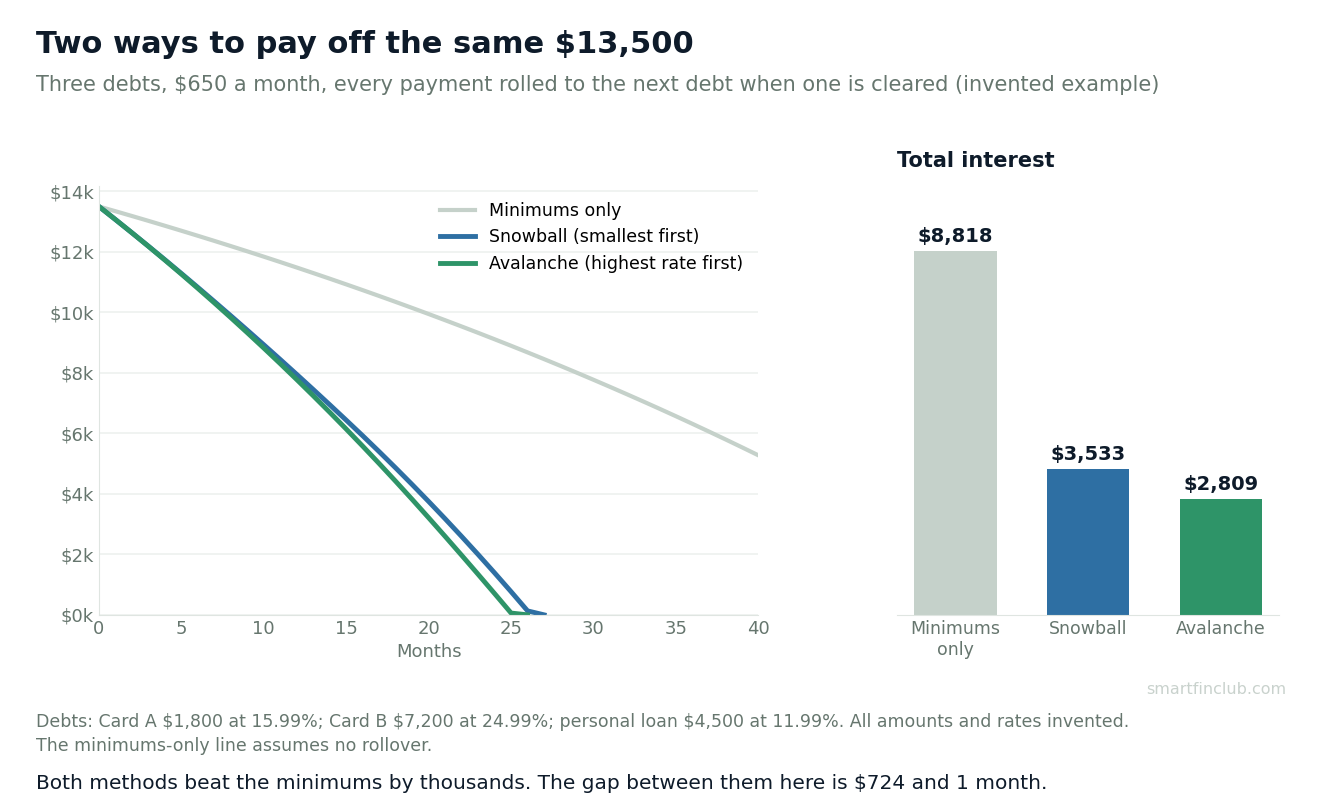
Suppose you owe $13,500 across three debts: Card A with $1,800 at 15.99%, Card B with $7,200 at 24.99% and a personal loan with $4,500 at 11.99%. The minimums add up to $375 a month. You can afford $650, so $275 is extra. Paying only the minimums and not rolling anything over, the debts take 76 months and cost $8,818 in interest.
| Method | Debt-free in | Total interest | First debt gone | Order cleared |
|---|---|---|---|---|
| Snowball | 27 months | $3,533 | Month 6 | Card A, loan, Card B |
| Avalanche | 26 months | $2,809 | Month 19 | Card B, Card A, loan |
Same $650 a month, same debts. Both rolled every freed-up payment to the next debt.
Avalanche wins on the numbers, but only just: about $724 less interest and 1 month sooner. Snowball gives you a first victory in month 6. With avalanche, you wait until month 19, because the debt with the highest rate is also the largest. Either way, you are debt-free in a little over two years. The minimums alone would take more than six.
How the payments roll from debt to debt
The mechanics are easier to see with the actual payments. Your minimums total $375, so $275 is left over each month. Under snowball, that extra goes to Card A, which receives $325 a month while Card B and the loan get only their minimums. Under avalanche, the extra goes to Card B, which receives $465.
When the first debt is cleared, nothing changes in your budget. Its whole payment moves to the next target. Under snowball, the $325 that was going to Card A joins the loan's $135 minimum, so the loan now receives $460. Under avalanche, Card B's $465 moves to Card A, which then receives $515. Either way, your monthly total stays at $650 until the last debt is gone. That fixed total is why the plan speeds up without costing you more each month.
Why the “worse” method sometimes wins
If the goal were pure arithmetic, everyone would use avalanche. But debt payoff takes months of discipline, and discipline responds to progress. A 2012 study by David Gal and Blakeley McShane in the Journal of Marketing Research looked at clients of a debt settlement firm who were working through multiple debts and found that the number of accounts they closed predicted whether they eliminated all their debt, regardless of how many dollars they had paid down. It is one study, not the last word, but it supports what many people report: closing an account feels like winning.
That is the case for snowball. A plan you abandon in month 10 costs more than a slightly less efficient plan you complete. Whichever method you choose, make the progress visible: a chart on the fridge, a spreadsheet you update on payday, or a calculator you revisit each month. Seeing the total fall is part of what keeps people going.
When the gap gets bigger
The difference depends on your balances and rates. Change the example so Card B, already the largest and most expensive debt, is $12,000, its minimum rises to $300, and the budget goes up to $700. Now snowball takes 37 months and costs $7,224, and avalanche takes 35 months and costs $6,151, a gap of $1,073. When one debt is both large and expensive, avalanche pulls further ahead.
A practical rule of thumb. If your highest-rate debt is not much bigger than the others, avalanche costs you little in time and saves interest. If it is huge and you are likely to lose steam, consider clearing one or two small debts first for the momentum, then switching to avalanche.
Questions to ask before you choose
- Do I lose steam on long goals? If you tend to lose steam without early wins, snowball's first payoff, in month 6 in our example, may matter more to you than a modest interest difference.
- Is any debt on a deadline? If a promotional rate is about to end, read the terms for what happens afterward. That debt may deserve to go first, whichever method you choose.
- Is one debt causing more stress than the rest? A debt that brings constant calls, or one you owe a friend or relative, may deserve priority for reasons the arithmetic does not capture.
- Is my income steady? If your pay varies from month to month, build the plan on a total you can meet even in a lean month, and add extra in better ones.
Which debts belong in the plan
Include the debts that charge you interest and that you want gone: credit cards, store cards, personal loans and, if the rate is high, car loans and some student loans. A mortgage usually stays on its normal schedule, and low-rate loans can wait. Federal student loans have protections that private debts lack, so treat them with care. Our student loan article covers the current rules.
Mistakes that quietly cost the most
- Letting the minimums slip. A late payment can bring fees and a higher rate, and that erases the interest you were trying to save.
- Not rolling the payment. When a debt is cleared, its old payment is the fuel for the next one. If it drifts back into your everyday spending, the plan slows to a crawl.
- Closing your budget to surprises. With no cushion, the first unexpected bill goes back on a card. A small starter emergency fund keeps the plan intact.
- Ignoring cheaper options. A lower rate through a transfer or consolidation loan can save more than the choice between snowball and avalanche.
When life interrupts the plan
Suppose a car repair swallows your extra money for two months. The minimums are the part you cannot skip. Pay them, pause the extra if you must, and restart when the budget allows. The plan slips by roughly the amount of extra you missed. It does not reset. If the interruption will last longer, contact your lenders before you fall behind and ask what options they offer. That is a much better conversation than the one after a missed payment.
Finding the extra money
In our example, $275 a month above the minimums is what does the work. If that number is smaller in your budget, even $50 or $100 extra moves the finish line closer. Look for it in a raise, a canceled subscription, a side income or a windfall such as a tax refund. Pointing one-time money at the target debt is one of the most effective moves you can make, because it lowers the balance that interest is charged on.
Where a windfall does the most
A simple way to compare debts is to ask what each $1,000 of balance costs you in interest per month. At the rates in our example, that is about $13 on Card A, $21 on Card B and $10 on the personal loan. So a $1,000 tax refund does the most work on Card B, stopping about $21 of interest for every month that money would otherwise have stayed on the balance. The wider the spread between your rates, the more this matters. Before you send lump sums to a loan, check that it does not charge a fee for paying early.
Getting started
- List every debt with its balance, rate and minimum. Your latest statements have all three.
- Decide your monthly total, the amount you will pay on debt every month, and keep it fixed even as debts disappear.
- Pick a method, and set up automatic minimum payments on all of them so no debt is ever late.
- Send all the extra to the target debt. When it is paid off, add its whole payment to the next.
- Do not add new balances to the cards you are paying down. A plan works only if the total is falling.
A ten-minute monthly check-in
- Open each account and write down the current balance next to last month's.
- Confirm that every minimum went through on time and that the target debt received the full extra amount.
- Update your running total and note how far it has fallen since you started.
- Scan the cards for new charges. If any appeared, find out why before next month.
- Decide where any one-time money coming up, such as a refund or bonus, will go.
If a lower rate is available, such as a 0% balance transfer or a consolidation loan, the arithmetic changes in your favor. Our article on 0% balance transfers covers when that helps. If you would like help building a plan, write to us at Info@smartfinclub.com.