On November 5, 2026 the IRS published its inflation adjustments for tax year 2027 in Revenue Procedure 2026-35. These are the numbers that will apply to income you earn from January 1, 2027, and to the return you file in early 2028. Brackets moved up by roughly 3%, the standard deduction rose again, and several credits and exclusions got larger. None of this changes the return you file next spring for 2026. But it does change how you should plan the next fourteen months.
Below are the headline figures, what they mean for three ordinary households, and the moves that are worth making before December 31 and during 2027.
The 2027 standard deduction
Most filers take the standard deduction rather than itemizing, so this is the number that matters most. For 2027 it is:
| Filing status | 2026 | 2027 | Change |
|---|---|---|---|
| Single or married filing separately | $16,100 | $16,600 | +$500 |
| Married filing jointly | $32,200 | $33,200 | +$1,000 |
| Head of household | $24,150 | $24,925 | +$775 |
If you are 65 or older, or blind, you add an extra $2,100 for 2027 if you are unmarried, or $1,700 per qualifying person if you are married. The separate $6,000 senior deduction created by the 2025 tax law is still available through 2028 for people 65 and older, and it phases out at higher incomes.
The 2027 tax brackets
The seven rates stay the same: 10%, 12%, 22%, 24%, 32%, 35% and 37%. What changes is where each one starts. Each figure below is the taxable income at which that rate begins.
| Rate | Single | Married filing jointly | Head of household |
|---|---|---|---|
| 10% | $0 | $0 | $0 |
| 12% | $12,800 | $25,600 | $18,250 |
| 22% | $52,025 | $104,050 | $69,650 |
| 24% | $109,125 | $218,250 | $109,100 |
| 32% | $208,325 | $416,650 | $208,300 |
| 35% | $264,550 | $529,100 | $264,550 |
| 37% | $661,375 | $793,650 | $661,350 |
Married couples filing separately use the single thresholds up to the 35% bracket, which for them ends at $396,825. Remember that only the dollars inside each band are taxed at that band's rate. If the difference between your bracket and your actual tax rate is fuzzy, Nobody Pays Their Tax Bracket walks through it.
What it means for three households
To see the effect, we ran the same wages through the 2026 and 2027 figures, with the standard deduction and no other income. Nothing about these households changes except the calendar.
- Single, $90,000 in wages. Federal income tax falls from $10,970 to about $10,690, a saving of about $280.
- Head of household, $60,000 in wages. Tax falls from $3,948 to $3,844, about $104 less.
- Married couple, $180,000 in wages, two children. Before credits, tax falls from $21,940 to $21,379. The child tax credit also rises from $2,200 to $2,300 per child, so the tax after the credit drops from $17,540 to $16,779, a saving of $761.
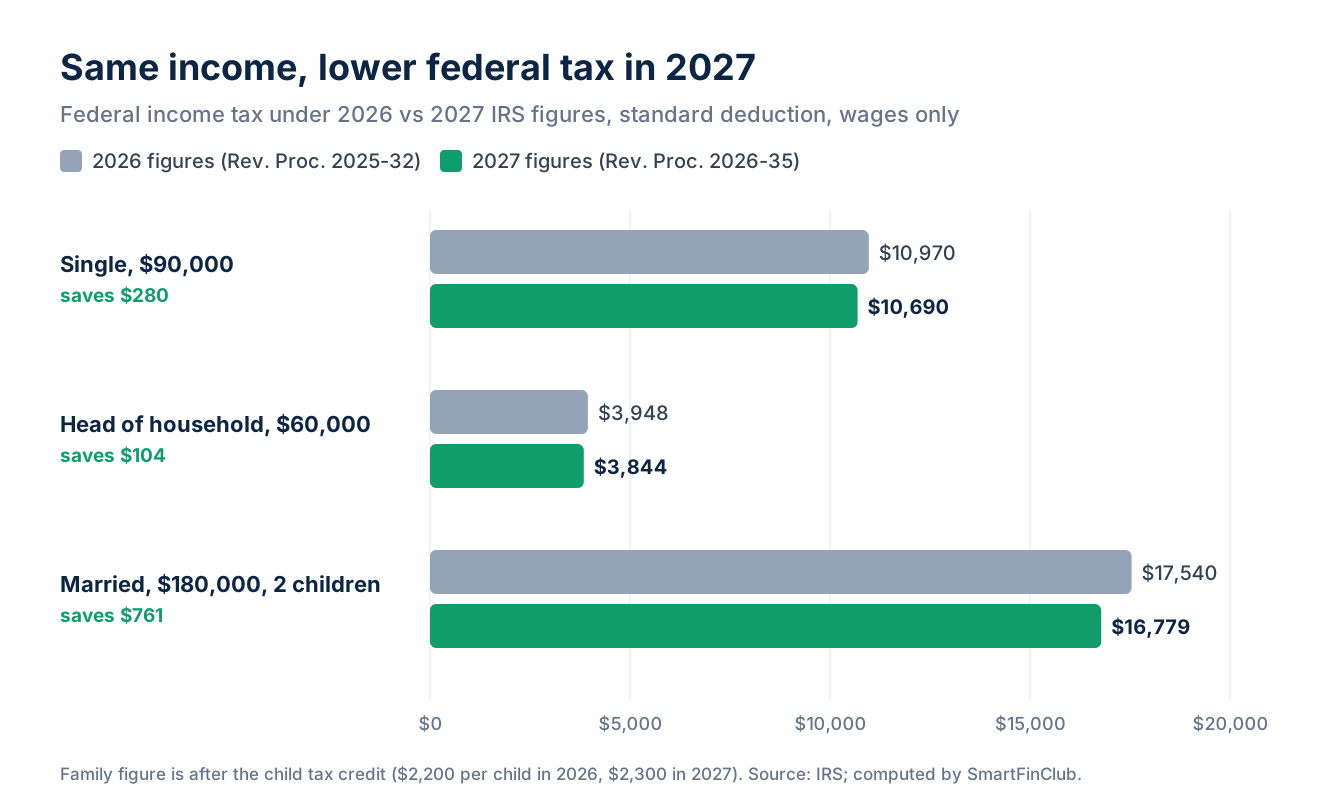
These savings are real but modest. The adjustments exist to stop inflation from pushing you into a higher bracket when your raise only kept up with prices, which is known as bracket creep. If your pay rises about 3% in 2027, your tax bill will rise less than it otherwise would have, but it will still rise.
Other 2027 figures worth knowing
- Child tax credit: $2,300 per qualifying child, with up to $1,800 of it refundable.
- Earned income tax credit: up to $8,496 with three or more children, $7,552 with two, $4,573 with one and $685 with none.
- Long-term capital gains: the 0% rate applies to taxable income up to $51,050 for single filers, $68,350 for heads of household and $102,100 for joint filers. The 20% rate starts above $563,200 single and $633,600 joint.
- Alternative minimum tax: the exemption is $93,000 for unmarried filers and $144,700 for joint filers, phasing out from $515,950 and $1,031,900.
- Annual gift exclusion: $20,000 per recipient, up from $19,000. The estate tax basic exclusion is $15,480,000.
- Health flexible spending account: $3,500 in salary reductions, with up to $700 carried over if your plan allows it.
- Health savings account (announced separately in Rev. Proc. 2026-24): $4,500 self-only and $9,000 family coverage.
- Social Security wage base: $192,300, announced by the Social Security Administration in October. Earnings above this are not subject to the 6.2% Social Security tax.
Two things are not in this release. The 401(k) and IRA contribution limits for 2027 come from a separate IRS notice, which had not been published when this article was written. And the temporary deductions for tips, overtime and car loan interest are set by statute at fixed dollar amounts, so they do not change for inflation.
Planning moves for the rest of 2026
Higher thresholds next year create a small timing opportunity. If you have flexibility over when income or deductions land, the general rule is to push income into the year it will be taxed less, and pull deductions into the year they save more.
- If you expect similar income in both years, deferring a year-end bonus, a freelance invoice or a capital gain into January 2027 means it will be measured against wider brackets. The saving is usually small, so only do it if the delay costs you nothing.
- If you itemize, consider bunching charitable gifts or property tax payments into the year you will actually itemize, and taking the higher standard deduction in the other year.
- Use up 2026 limits that do not carry forward, including your 401(k) deferrals and your 2026 FSA balance. You have until April 15, 2027 to make 2026 IRA and HSA contributions.
- Check room for a Roth conversion. A conversion done in December is taxed as 2026 income. Converting only the amount that fills your current bracket is often the cheapest way to do it, as The Tax Bill You Choose Beats the One You Are Handed explains.
- Harvest gains at 0% if you qualify. If your taxable income is under the 0% capital gains ceiling, you may be able to sell appreciated investments and rebuy them to reset your cost basis without owing federal tax.
Planning moves for 2027
- Revisit your W-4 in January. Payroll systems update their withholding tables for the new brackets, but they do not know about your side income, your new child or your spouse's raise. A quick check early in the year avoids a surprise in April 2028.
- Raise your automatic savings. If your take-home pay rises a little because of the new brackets, direct that difference to your retirement account or emergency fund before you get used to spending it.
- Adjust estimated payments if you are self-employed. The higher Social Security wage base means high earners pay self-employment tax on more income in 2027.
- Plan gifts against the new $20,000 exclusion. A married couple can give $40,000 per recipient in 2027 without filing a gift tax return.
- Watch for the 401(k) and IRA limits. Once the IRS announces them, update your payroll deferral so you reach the new maximum, or your employer match, by year end.
Common mistakes to avoid
- Using 2027 figures to estimate the 2026 return you file next spring. That return still uses the 2026 brackets and deduction.
- Delaying income into 2027 when you expect a much larger income next year. A wider bracket does not help if you will be in a higher one.
- Assuming a raise could lower your take-home pay. Only the extra dollars are taxed at the higher rate.
Sources: IRS news release IR-2026-133 · Rev. Proc. 2026-35 · Rev. Proc. 2026-24 (HSA limits) · Journal of Accountancy: 2027 Social Security wage base. Household examples computed by SmartFinClub with the standard deduction and no other income or credits except the child tax credit where stated.
Related reading on FinTalks: Tax Moves for 2027: What to Start Now, and What Can Wait and Nobody Pays Their Tax Bracket.
None of this is a recommendation for you. The right timing depends on your income in both years, your deductions and your state taxes. If you would like help thinking it through, write to us at Info@smartfinclub.com, or speak with a CPA or enrolled agent.
Try the numbers yourself: every SmartFinClub tax calculator now has a Tax year picker with 2027. Start with the Tax Bracket Calculator, Take-Home Pay Calculator, Tax Refund & W-4 Estimator and Capital Gains Tax Calculator.